窳 (yǔ) means "inferior / bad / corrupt" in Chinese. It has 15 strokes with the radical 穴.
Rated 4.2/5 in difficulty (advanced).
Appears in 3+ common words including 窳陋 (yǔ lòu), 窳劣 (yǔ liè), 窳败 (yǔ bài).
Due to its 15 strokes, Hanzi Writer's error detection shows 窳 requires focused practice — most learners need 10+ attempts for consistent accuracy.
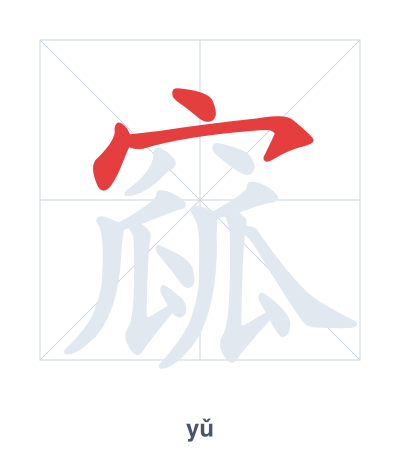
Open Hanzi Writer to see the animated stroke order and practice writing 窳 with real-time feedback.
The character 窳 (yǔ) is written with 15 strokes. Follow the standard Chinese stroke order: top to bottom, left to right, outside before inside. The radical 穴 is one of its key components.
Practice the correct stroke order with the Hanzi Writer app to see animated stroke-by-stroke guidance with real-time feedback.
窳 means inferior / bad / corrupt.
窳 is a phono-semantic compound: the radical 穴 (cave) suggests a dilapidated or unsafe hole, while 㕦 (yǔ) hints at the sound. Its original meaning was a decayed or unsound cave, which later generalized to anything inferior, bad, or corrupt.
💡 Memory Tip: Picture a cave (穴) with a crooked, decaying figure inside (the lower part) — that’s definitely inferior.
这里的环境很窳陋。
zhè lǐ de huán jìng hěn yǔ lòu
The environment here is shabby and dilapidated.
这种产品的质量很窳劣。
zhè zhǒng chǎn pǐn de zhì liàng hěn yǔ liè
The quality of this product is very poor.
那个制度已经窳败了。
nà ge zhì dù yǐ jīng yǔ bài le
That system has already become corrupt and decayed.
Open Hanzi Writer to see the animated stroke order and practice writing 窳 with real-time feedback.
✨ Animated stroke order · Handwriting recognition · HSK-graded practice · Free to use
The character 窳 is built with the radical 穴 (cave) on top, and the bottom part is 㕜 (a component not used alone). The cave radical suggests something hidden or defective, and the bottom part adds the idea of decay or corruption, together forming the meaning of inferior or bad.