窣 (sū) means "rustle (sound)" in Chinese. It has 13 strokes with the radical 穴.
Rated 4.2/5 in difficulty (advanced).
Appears in 3+ common words including 窸窣 (xī sū), 窣窣 (sū sū), 窣静 (sū jìng).
Due to its 13 strokes, Hanzi Writer's error detection shows 窣 requires focused practice — most learners need 10+ attempts for consistent accuracy.
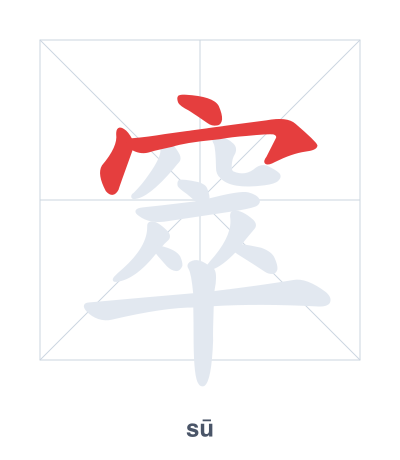
Open Hanzi Writer to see the animated stroke order and practice writing 窣 with real-time feedback.
The character 窣 (sū) is written with 13 strokes. Follow the standard Chinese stroke order: top to bottom, left to right, outside before inside. The radical 穴 is one of its key components.
Practice the correct stroke order with the Hanzi Writer app to see animated stroke-by-stroke guidance with real-time feedback.
窣 means rustle (sound).
窣 is a phono-semantic compound: the radical 穴 (cave/hole) hints at an enclosed space, while 卒 (soldier) provides the sound sū. The meaning 'rustle' likely evokes the soft, scraping noise of something moving inside a dark cave or the swish of a soldier's clothing.
💡 Memory Tip: A soldier (卒) in a cave (穴) rustles his armor, making a soft 'sū' sound.
草丛里有窸窣声。
cǎo cóng lǐ yǒu xī sū shēng
There is a rustling sound in the grass.
树叶窣窣作响。
shù yè sū sū zuò xiǎng
The leaves are rustling softly.
夜晚的森林很窣静。
yè wǎn de sēn lín hěn sū jìng
The forest is very quiet at night.
Open Hanzi Writer to see the animated stroke order and practice writing 窣 with real-time feedback.
✨ Animated stroke order · Handwriting recognition · HSK-graded practice · Free to use
窣 is made of the radical 穴 (cave) on top and the phonetic component 卒 (zú) below. The cave radical hints at a hidden or enclosed space where soft sounds like rustling occur. This structure combines the idea of a quiet place with a sound symbol to create the meaning of a rustling noise.