狃 (niǔ) means "To be accustomed to or to be intimate with." in Chinese. It has 7 strokes with the radical 犭.
Rated 3.5/5 in difficulty (challenging).
Appears in 3+ common words including 狃于 (niǔ yú), 狃恩 (niǔ ēn), 狃见 (niǔ jiàn).
Due to its 7 strokes, Hanzi Writer's error detection shows 狃 requires focused practice — most learners need 10+ attempts for consistent accuracy.
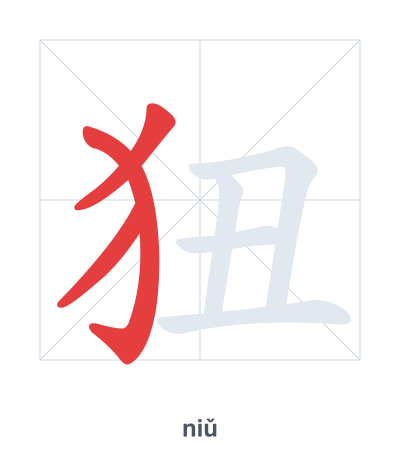
Open Hanzi Writer to see the animated stroke order and practice writing 狃 with real-time feedback.
The character 狃 (niǔ) is written with 7 strokes. Follow the standard Chinese stroke order: top to bottom, left to right, outside before inside. The radical 犭 is one of its key components.
Practice the correct stroke order with the Hanzi Writer app to see animated stroke-by-stroke guidance with real-time feedback.
狃 means To be accustomed to or to be intimate with..
狃 is a compound character with the radical 犭 (dog) indicating an animal's behavior, and 丑 (chǒu) as a phonetic component. The meaning 'to be accustomed' or 'intimate' likely derives from a dog's repeated interaction with its owner, leading to familiarity and closeness.
💡 Memory Tip: Picture a dog (犭) that becomes so accustomed to its owner's ugly face (丑) that it snuggles up intimately.
他狃于旧习,不愿改变。
tā niǔ yú jiù xí bù yuàn gǎi biàn
He is stuck in his old habits and unwilling to change.
他狃恩自重,不听劝告。
tā niǔ ēn zì zhòng bù tīng quàn gào
He presumed on favor and acted willfully, ignoring advice.
这只是他的狃见而已。
zhè zhǐ shì tā de niǔ jiàn ér yǐ
This is just his biased view.
Open Hanzi Writer to see the animated stroke order and practice writing 狃 with real-time feedback.
✨ Animated stroke order · Handwriting recognition · HSK-graded practice · Free to use
狃 has two parts: the radical 犭 (animal) on the left and the phonetic component 丑 on the right. The radical suggests the meaning relates to animal behavior, such as being used to something. The right side 丑 gives a clue to the pronunciation niǔ.