Hanzi Writer

How to Write 俑 (yǒng) — Meaning “funerary figurine”

yǒng 9 strokes Radical: 亻

俑 (yǒng) means "funerary figurine" in Chinese. It has 9 strokes with the radical 亻.

Rated 3.7/5 in difficulty (challenging).

Appears in 3+ common words including 兵马俑 (bīng mǎ yǒng), 陶俑 (táo yǒng), 始作俑者 (shǐ zuò yǒng zhě).

Due to its 9 strokes, Hanzi Writer's error detection shows 俑 requires focused practice — most learners need 10+ attempts for consistent accuracy.
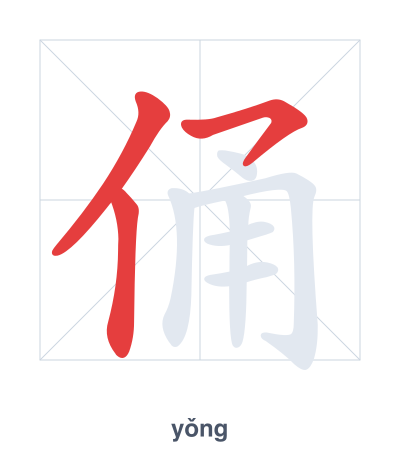
Stroke order practice for 俑 - yǒng

Practice Writing 俑 (yǒng)

Open Hanzi Writer to see the animated stroke order and practice writing 俑 with real-time feedback.

The character (yǒng) is written with 9 strokes. Follow the standard Chinese stroke order: top to bottom, left to right, outside before inside. The radical is one of its key components.

Practice the correct stroke order with the Hanzi Writer app to see animated stroke-by-stroke guidance with real-time feedback.

means funerary figurine.

Character
Pinyinyǒng (yong)
Meaningfunerary figurine
Strokes9
Radical
Difficulty3.7/5

俑 combines the person radical 亻 with 甬, which originally depicted a hollow vessel or a tomb passage. Together, it signifies a human figurine placed in tombs to serve the deceased in the afterlife.

💡 Memory Tip: Picture a person (亻) standing stiffly inside a dark tomb passage (甬) as a silent funerary figurine.

bīng mǎ yǒng
Terracotta Warriors
táo yǒng
pottery figurine
shǐ zuò yǒng zhě
the person who started an evil trend; the initiator

我去西安看兵马俑。

wǒ qù xī ān kàn bīng mǎ yǒng

I'm going to Xi'an to see the Terracotta Warriors.

博物馆里有陶俑。

bó wù guǎn lǐ yǒu táo yǒng

There are pottery figurines in the museum.

谁是始作俑者?

shuí shì shǐ zuò yǒng zhě

Who started this? / Who was the initiator?

Character Pinyin Strokes Radical
(current) yǒng 9
7
gū / gù 7
7
Stroke order practice for 俑 - yǒng

Practice Writing 俑 (yǒng)

Open Hanzi Writer to see the animated stroke order and practice writing 俑 with real-time feedback.

✨ Animated stroke order · Handwriting recognition · HSK-graded practice · Free to use

Frequently Asked Questions about 俑

俑 combines the radical 亻 (person) on the left with 甬 (yǒng) on the right. The left part shows it relates to people, and the right part 甬 originally meant a path or a tomb passage, so together they suggest a "person" placed in a tomb — a funerary figurine.

Characters with Radical 亻

Other 9-Stroke Characters