兵 (bīng) means "Soldier; weapon" in Chinese. It has 7 strokes with the radical 八, and is HSK Level 4.
Rated 3.2/5 in difficulty (challenging).
Harder than 17% of HSK Level 4 characters.
Appears in 3+ common words including 士兵 (shì bīng), 当兵 (dāng bīng), 兵法 (bīng fǎ).
Due to its 7 strokes, Hanzi Writer's error detection shows 兵 requires focused practice — most learners need 10+ attempts for consistent accuracy.
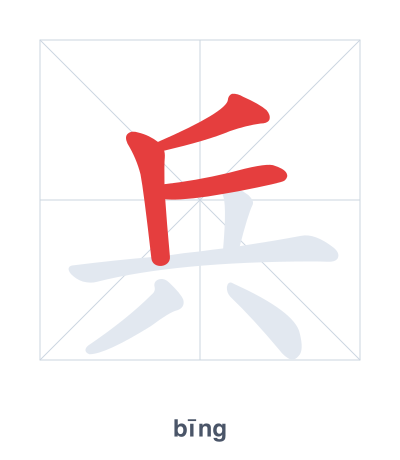
Open Hanzi Writer to see the animated stroke order and practice writing 兵 with real-time feedback.
The character 兵 (bīng) is written with 7 strokes. Follow the standard Chinese stroke order: top to bottom, left to right, outside before inside. The radical 八 is one of its key components.
Practice the correct stroke order with the Hanzi Writer app to see animated stroke-by-stroke guidance with real-time feedback.
兵 means Soldier; weapon.
As an HSK Level 4 character, 兵 is an intermediate-level character.
Originally a pictograph of two hands (廾) holding a battle-axe (斤), symbolizing a weapon or soldier. Over time, the axe head evolved into the top component 丘 (hill), and the hands simplified to 八 (eight) at the bottom.
💡 Memory Tip: Picture a soldier standing on a hill (丘) with eight (八) weapons strapped to his back.
他是一个士兵。
tā shì yí gè shì bīng
He is a soldier.
他想去当兵。
tā xiǎng qù dāng bīng
He wants to join the army.
孙子兵法很有名。
sūn zi bīng fǎ hěn yǒu míng
The Art of War by Sun Tzu is very famous.
Open Hanzi Writer to see the animated stroke order and practice writing 兵 with real-time feedback.
✨ Animated stroke order · Handwriting recognition · HSK-graded practice · Free to use
兵 is composed of 丘 (hill) on top and 八 (eight) on the bottom. Originally it depicted two hands holding a battle-axe, symbolizing a soldier or weapon. This structure emphasizes the connection between military force and action.