揶 (yé) means "to mock; to ridicule" in Chinese. It has 11 strokes with the radical 扌.
Rated 4.2/5 in difficulty (advanced).
Appears in 3+ common words including 揶揄 (yé yú), 被揶揄 (bèi yé yú), 揶揄地笑 (yé yú dì xiào).
Due to its 11 strokes, Hanzi Writer's error detection shows 揶 requires focused practice — most learners need 10+ attempts for consistent accuracy.
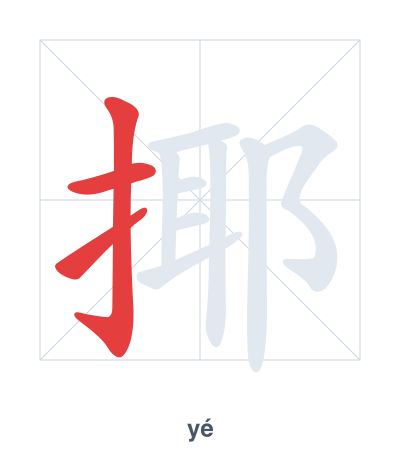
Open Hanzi Writer to see the animated stroke order and practice writing 揶 with real-time feedback.
The character 揶 (yé) is written with 11 strokes. Follow the standard Chinese stroke order: top to bottom, left to right, outside before inside. The radical 扌 is one of its key components.
Practice the correct stroke order with the Hanzi Writer app to see animated stroke-by-stroke guidance with real-time feedback.
揶 means to mock; to ridicule.
揶 combines the hand radical 扌 (action) with 耶 (yé, phonetic), originally referring to a mocking hand gesture or teasing action, as seen in the compound word 揶揄 (yéyú) meaning 'to ridicule.'
💡 Memory Tip: Picture a hand (扌) pulling someone's ear (耳) while mockingly yelling 'Yé!' to ridicule them.
他总是揶揄朋友。
tā zǒng shì yé yú péng yǒu
He is always teasing his friends.
他被大家揶揄了。
tā bèi dà jiā yé yú le
He was teased by everyone.
他揶揄地笑了一下。
tā yé yú dì xiào le yī xià
He gave a mocking smile.
Open Hanzi Writer to see the animated stroke order and practice writing 揶 with real-time feedback.
✨ Animated stroke order · Handwriting recognition · HSK-graded practice · Free to use
揶 has a left-right structure. The left side is the radical 扌 (hand), suggesting an action done with the hand. The right side is 耶 (yé), which provides the sound and also carries a sense of 'to raise' or 'to extend' – together hinting at the hand gesture of mocking or teasing.