阋 (xì) means "to feud; to quarrel" in Chinese. It has 11 strokes with the radical 门.
Rated 4.2/5 in difficulty (advanced).
Appears in 3+ common words including 阋墙 (xì qiáng), 阋讼 (xì sòng), 阋斗 (xì dòu).
Due to its 11 strokes, Hanzi Writer's error detection shows 阋 requires focused practice — most learners need 10+ attempts for consistent accuracy.
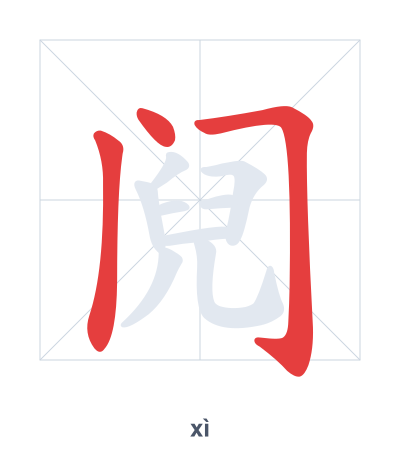
Open Hanzi Writer to see the animated stroke order and practice writing 阋 with real-time feedback.
The character 阋 (xì) is written with 11 strokes. Follow the standard Chinese stroke order: top to bottom, left to right, outside before inside. The radical 门 is one of its key components.
Practice the correct stroke order with the Hanzi Writer app to see animated stroke-by-stroke guidance with real-time feedback.
阋 means to feud; to quarrel.
Originally written as 鬩, combining 鬥 (two fighters) and 兒 (child, phonetic), meaning quarrel. The simplified form 阋 uses 门 (gate) as a radical, symbolizing a dispute within a household.
💡 Memory Tip: Imagine two children (兒) having a loud quarrel right at the gate (门) of their house.
他们兄弟阋墙,让人叹息。
tā men xiōng dì xì qiáng ràng rén tàn xī
It's a pity that the brothers are fighting among themselves.
家人之间不应该有阋讼。
jiā rén zhī jiān bù yīng gāi yǒu xì sòng
There should be no feuds or lawsuits among family members.
内部的阋斗削弱了力量。
nèi bù de xì dòu xuē ruò le lì liàng
Internal feuding weakened their strength.
Open Hanzi Writer to see the animated stroke order and practice writing 阋 with real-time feedback.
✨ Animated stroke order · Handwriting recognition · HSK-graded practice · Free to use
阋 combines the door radical 门 with the component 兒 (child). The door suggests a house or enclosure, and the child inside represents family members quarreling at home, which leads to the meaning "to feud."