捂 (wǔ) means "to cover (with one's hands)" in Chinese. It has 10 strokes with the radical 扌, and is HSK Level 7.
Rated 4.2/5 in difficulty (advanced).
Harder than 58% of HSK Level 7 characters.
Appears in 3+ common words including 捂住 (wǔ zhù), 捂脸 (wǔ liǎn), 捂耳朵 (wǔ ěr duǒ).
Due to its 10 strokes, Hanzi Writer's error detection shows 捂 requires focused practice — most learners need 10+ attempts for consistent accuracy.
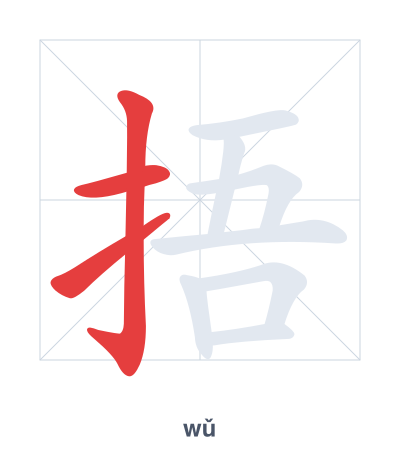
Open Hanzi Writer to see the animated stroke order and practice writing 捂 with real-time feedback.
The character 捂 (wǔ) is written with 10 strokes. Follow the standard Chinese stroke order: top to bottom, left to right, outside before inside. The radical 扌 is one of its key components.
Practice the correct stroke order with the Hanzi Writer app to see animated stroke-by-stroke guidance with real-time feedback.
捂 means to cover (with one's hands).
As an HSK Level 7 character, 捂 is an intermediate-level character.
捂 combines the hand radical 扌 with 吾 (wú), which in its ancient form depicted a hand covering a mouth. Together, they convey the action of covering something with one's hand.
💡 Memory Tip: Picture your hand (扌) covering your mouth as you let out a muffled 'Woo!' (wǔ) to hide the sound.
他用手捂住了嘴巴。
tā yòng shǒu wǔ zhù le zuǐ bā
He covered his mouth with his hand.
那个孩子害羞地捂脸。
nà ge hái zi hài xiū dì wǔ liǎn
That child covered their face shyly.
声音太大,快捂耳朵。
shēng yīn tài dà kuài wǔ ěr duǒ
The sound is too loud, cover your ears quickly.
Open Hanzi Writer to see the animated stroke order and practice writing 捂 with real-time feedback.
✨ Animated stroke order · Handwriting recognition · HSK-graded practice · Free to use
捂 combines the radical 扌 (hand) on the left with 吾 (wú) on the right. The hand radical directly indicates that the action is done with one's hands, while 吾 provides pronunciation and originally relates to "I" or "my," helping to remember that you use your own hand to cover.