诿 (wěi) means "To shirk; to shift (responsibility)" in Chinese. It has 10 strokes with the radical 讠.
Rated 3.9/5 in difficulty (challenging).
Appears in 3+ common words including 推诿 (tuī wěi), 诿过 (wěi guò), 诿托 (wěi tuō).
Due to its 10 strokes, Hanzi Writer's error detection shows 诿 requires focused practice — most learners need 10+ attempts for consistent accuracy.
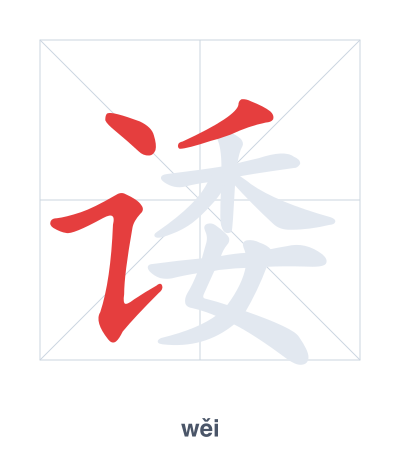
Open Hanzi Writer to see the animated stroke order and practice writing 诿 with real-time feedback.
The character 诿 (wěi) is written with 10 strokes. Follow the standard Chinese stroke order: top to bottom, left to right, outside before inside. The radical 讠 is one of its key components.
Practice the correct stroke order with the Hanzi Writer app to see animated stroke-by-stroke guidance with real-time feedback.
诿 means To shirk; to shift (responsibility).
诿 is a phono-semantic compound. The radical 讠 (言) represents speech or words, while 委 (wěi) originally meant 'to entrust' or 'to delegate'. Together, they suggest using words to shift or shirk responsibility, turning delegation into evasion.
💡 Memory Tip: Imagine a person using words (讠) to hand a heavy load of wheat (禾) to a woman (女), slyly passing the responsibility to someone else.
不要互相推诿责任。
bú yào hù xiāng tuī wěi zé rèn
Don't shift responsibility onto each other.
他总是向别人诿过。
tā zǒng shì xiàng bié rén wěi guò
He always shifts the blame onto others.
他诿托生病不来。
tā wěi tuō shēng bìng bù lái
He used illness as an excuse for not coming.
Open Hanzi Writer to see the animated stroke order and practice writing 诿 with real-time feedback.
✨ Animated stroke order · Handwriting recognition · HSK-graded practice · Free to use
诿 is a left-right structure. The left radical 讠 (speech) suggests actions done through words, while the right part 委 (wěi, to entrust) hints at the idea of passing something off. Together, they form the meaning of shifting responsibility through excuses or speech.