醄 (táo) means "drunk and happy" in Chinese. It has 15 strokes with the radical 酉.
Rated 4.2/5 in difficulty (advanced).
Appears in 3+ common words including 醄醄 (táo táo), 醉醄醄 (zuì táo táo), 陶醄 (táo táo).
Due to its 15 strokes, Hanzi Writer's error detection shows 醄 requires focused practice — most learners need 10+ attempts for consistent accuracy.
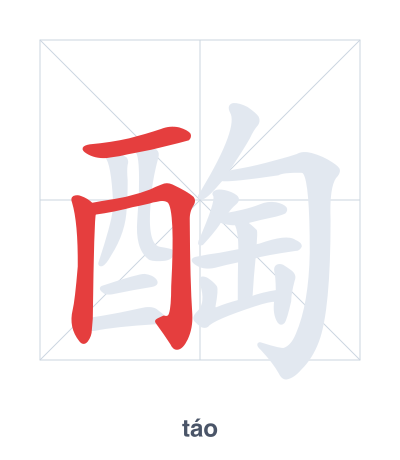
Open Hanzi Writer to see the animated stroke order and practice writing 醄 with real-time feedback.
The character 醄 (táo) is written with 15 strokes. Follow the standard Chinese stroke order: top to bottom, left to right, outside before inside. The radical 酉 is one of its key components.
Practice the correct stroke order with the Hanzi Writer app to see animated stroke-by-stroke guidance with real-time feedback.
醄 means drunk and happy.
This compound character combines the radical 酉 (wine jar) with 匋 (táo, meaning pottery or to mold), suggesting a state where wine shapes one's mood into happy drunkenness. The left side evokes alcohol, while the right side phonetically hints at the molding effect of drink.
💡 Memory Tip: Imagine a wine jar (酉) that molds you like clay (匋) into a blissfully drunk and cheerful person.
他喝得醄醄大醉。
tā hē dé táo táo dà zuì
He was completely intoxicated.
他醉醄醄地回家了。
tā zuì táo táo dì huí jiā le
He went home happily drunk.
这种感觉很陶醄。
zhè zhǒng gǎn jué hěn táo táo
This feeling is very joyful and carefree.
Open Hanzi Writer to see the animated stroke order and practice writing 醄 with real-time feedback.
✨ Animated stroke order · Handwriting recognition · HSK-graded practice · Free to use
The left side is 酉, which means wine or alcohol, showing the character relates to drinking. The right side is 匋 (táo), which gives the pronunciation and also suggests the idea of being carefree or joyfully intoxicated, together forming the meaning 'drunk and happy'.