谭 (tán) means "to talk; (a surname)" in Chinese. It has 14 strokes with the radical 讠.
Rated 3.9/5 in difficulty (challenging).
Appears in 3+ common words including 谭先生 (tán xiān shēng), 天方夜谭 (tiān fāng yè tán), 老谭 (lǎo tán).
Due to its 14 strokes, Hanzi Writer's error detection shows 谭 requires focused practice — most learners need 10+ attempts for consistent accuracy.
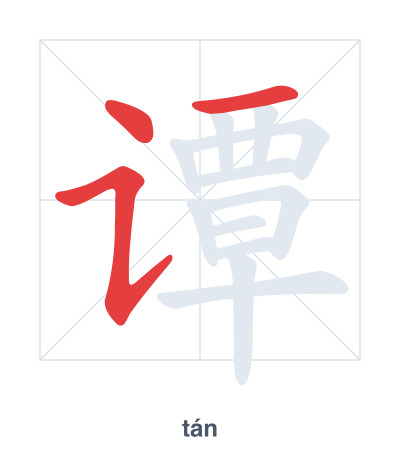
Open Hanzi Writer to see the animated stroke order and practice writing 谭 with real-time feedback.
The character 谭 (tán) is written with 14 strokes. Follow the standard Chinese stroke order: top to bottom, left to right, outside before inside. The radical 讠 is one of its key components.
Practice the correct stroke order with the Hanzi Writer app to see animated stroke-by-stroke guidance with real-time feedback.
谭 means to talk; (a surname).
谭 is a phono-semantic compound: the radical 讠 (speech) indicates the meaning of talking, while the component 覃 (tán, meaning 'deep' and providing pronunciation) suggests extended or profound conversation. Together, they convey 'to talk' or 'to discuss.'
💡 Memory Tip: Imagine someone speaking (讠) so early (早) in the west (西) that they start a deep, long talk.
谭先生是我的老师。
tán xiān shēng shì wǒ de lǎo shī
Mr. Tan is my teacher.
这简直是天方夜谭。
zhè jiǎn zhí shì tiān fāng yè tán
This is simply a fantasy.
老谭今天没来上班。
lǎo tán jīn tiān méi lái shàng bān
Old Tan didn't come to work today.
Open Hanzi Writer to see the animated stroke order and practice writing 谭 with real-time feedback.
✨ Animated stroke order · Handwriting recognition · HSK-graded practice · Free to use
谭 is made of the speech radical 讠 on the left, which relates to talking or language. The right part 覃 (pronounced tán) gives the sound and originally meant "deep," hinting at deep or lengthy talk.