獭 (tǎ) means "Otter" in Chinese. It has 16 strokes with the radical 犭.
Rated 4.2/5 in difficulty (advanced).
Appears in 3+ common words including 水獭 (shuǐ tǎ), 海獭 (hǎi tǎ), 獭皮 (tǎ pí).
Due to its 16 strokes, Hanzi Writer's error detection shows 獭 requires focused practice — most learners need 10+ attempts for consistent accuracy.
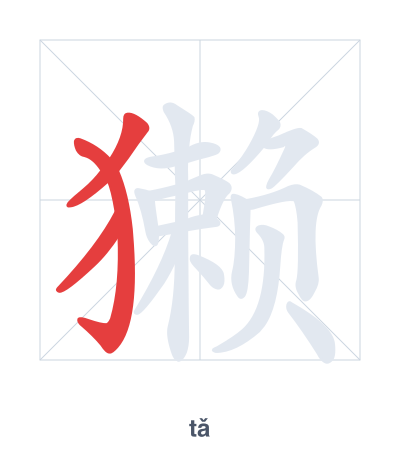
Open Hanzi Writer to see the animated stroke order and practice writing 獭 with real-time feedback.
The character 獭 (tǎ) is written with 16 strokes. Follow the standard Chinese stroke order: top to bottom, left to right, outside before inside. The radical 犭 is one of its key components.
Practice the correct stroke order with the Hanzi Writer app to see animated stroke-by-stroke guidance with real-time feedback.
獭 means Otter.
獭 is a phono-semantic compound: the radical 犭 (animal) indicates it's a mammal, while the right side 赖 (lài) provides the phonetic hint. The otter, a water-dwelling animal, is depicted through this combination of meaning and sound.
💡 Memory Tip: Imagine an otter (犭) playfully carrying a bundle of fish (赖, resembling a load on its back) as it swims.
水獭在水里游泳。
shuǐ tǎ zài shuǐ lǐ yóu yǒng
The otter is swimming in the water.
海獭的样子很可爱。
hǎi tǎ de yàng zi hěn kě ài
Sea otters look very cute.
这件衣服是獭皮做的。
zhè jiàn yī fú shì tǎ pí zuò de
This garment is made of otter fur.
Open Hanzi Writer to see the animated stroke order and practice writing 獭 with real-time feedback.
✨ Animated stroke order · Handwriting recognition · HSK-graded practice · Free to use
The character 獭 is made of the radical 犭 on the left, which means "animal" or "beast." The right part is 赖, which provides the pronunciation "lai" but does not directly contribute to the meaning. So 獭 literally means "otter animal," with the radical signaling it is a type of mammal.