嗖 (sōu) means "Whizzing; whooshing" in Chinese. It has 12 strokes with the radical 口.
Rated 4.2/5 in difficulty (advanced).
Appears in 3+ common words including 嗖地 (sōu dì), 嗖嗖 (sōu sōu), 嗖的一下 (sōu de yī xià).
Due to its 12 strokes, Hanzi Writer's error detection shows 嗖 requires focused practice — most learners need 10+ attempts for consistent accuracy.
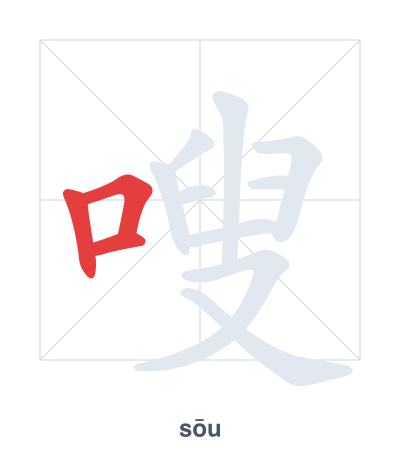
Open Hanzi Writer to see the animated stroke order and practice writing 嗖 with real-time feedback.
The character 嗖 (sōu) is written with 12 strokes. Follow the standard Chinese stroke order: top to bottom, left to right, outside before inside. The radical 口 is one of its key components.
Practice the correct stroke order with the Hanzi Writer app to see animated stroke-by-stroke guidance with real-time feedback.
嗖 means Whizzing; whooshing.
嗖 combines the mouth radical (口), indicating a sound, with the phonetic component 叟 (sǒu, meaning 'old man'). The character mimics the whistling or whooshing noise of something speeding through the air, like an arrow or wind.
💡 Memory Tip: Picture an old man (叟) opening his mouth (口) wide as a speeding arrow whizzes past him, making a loud "sōu" sound.
箭嗖地一声飞走了。
jiàn sōu dì yī shēng fēi zǒu le
The arrow flew away with a whoosh.
冷风嗖嗖地吹。
lěng fēng sōu sōu dì chuī
The cold wind is whistling.
猫嗖的一下跑了。
māo sōu de yī xià pǎo le
The cat dashed away in a flash.
Open Hanzi Writer to see the animated stroke order and practice writing 嗖 with real-time feedback.
✨ Animated stroke order · Handwriting recognition · HSK-graded practice · Free to use
嗖 is made of two parts: the left radical 口 (mouth) and the right component 叟 (sǒu, meaning 'old man'). The mouth radical shows that this character is used for sounds or noises, while 叟 gives the pronunciation. Together, 嗖 represents a whizzing or whooshing sound, like something moving fast through the air.