撕 (sī) means "to tear; to rip" in Chinese. It has 15 strokes with the radical 扌, and is HSK Level 7.
Rated 4.2/5 in difficulty (advanced).
Harder than 61% of HSK Level 7 characters.
Appears in 3+ common words including 撕开 (sī kāi), 撕掉 (sī diào), 撕破 (sī pò).
Due to its 15 strokes, Hanzi Writer's error detection shows 撕 requires focused practice — most learners need 10+ attempts for consistent accuracy.
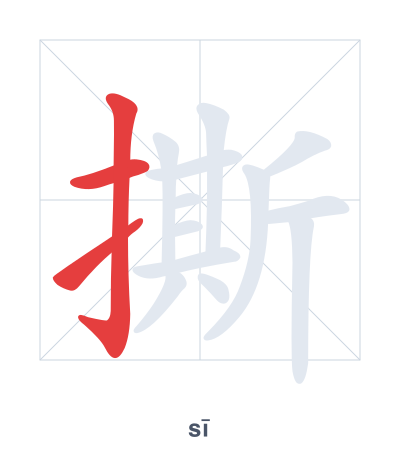
Open Hanzi Writer to see the animated stroke order and practice writing 撕 with real-time feedback.
The character 撕 (sī) is written with 15 strokes. Follow the standard Chinese stroke order: top to bottom, left to right, outside before inside. The radical 扌 is one of its key components.
Practice the correct stroke order with the Hanzi Writer app to see animated stroke-by-stroke guidance with real-time feedback.
撕 means to tear; to rip.
As an HSK Level 7 character, 撕 is an intermediate-level character.
撕 is a phono-semantic compound: the hand radical 扌 indicates the action of tearing, while 斯 (sī) provides the pronunciation and originally depicted an axe splitting wood, reinforcing the idea of dividing or ripping apart.
💡 Memory Tip: Imagine your hand (扌) gripping a sheet of paper and ripping it in two with a loud 'sī' sound.
请撕开这个包装。
qǐng sī kāi zhè ge bāo zhuāng
Please tear open this package.
他撕掉了旧照片。
tā sī diào le jiù zhào piān
He tore up the old photo.
衣服被撕破了。
yī fú bèi sī pò le
The clothes were torn.
Open Hanzi Writer to see the animated stroke order and practice writing 撕 with real-time feedback.
✨ Animated stroke order · Handwriting recognition · HSK-graded practice · Free to use
撕 combines the radical 扌 (hand) on the left, indicating an action done with the hand, and the phonetic component 斯 (sī) on the right, which gives the pronunciation. The hand radical directly connects to the meaning of tearing or ripping, which is a hand-based action.