曙 (shǔ) means "dawn; daybreak" in Chinese. It has 17 strokes with the radical 日, and is HSK Level 7.
Rated 4.2/5 in difficulty (advanced).
Harder than 62% of HSK Level 7 characters.
Appears in 3+ common words including 曙光 (shǔ guāng), 黎曙 (lí shǔ), 曙色 (shǔ sè).
Due to its 17 strokes, Hanzi Writer's error detection shows 曙 requires focused practice — most learners need 10+ attempts for consistent accuracy.
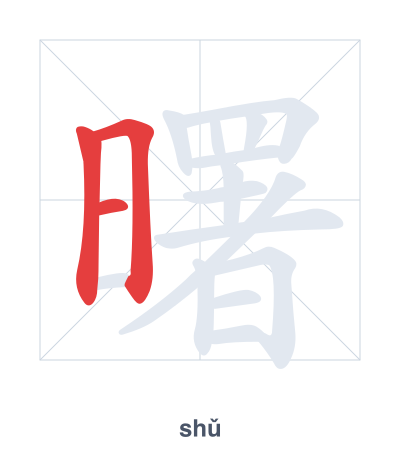
Open Hanzi Writer to see the animated stroke order and practice writing 曙 with real-time feedback.
The character 曙 (shǔ) is written with 17 strokes. Follow the standard Chinese stroke order: top to bottom, left to right, outside before inside. The radical 日 is one of its key components.
Practice the correct stroke order with the Hanzi Writer app to see animated stroke-by-stroke guidance with real-time feedback.
曙 means dawn; daybreak.
As an HSK Level 7 character, 曙 is an intermediate-level character.
曙 is a phono-semantic compound: the sun radical (日) on the left signifies light and daybreak, while 署 (shǔ) on the right gives the pronunciation. The sun rising over an office or a net (from 署's components) evokes the first light of dawn.
💡 Memory Tip: At dawn, the sun (日) shines through a net (罒) held up by a person (者) to catch the morning light.
我们看到了曙光。
wǒ men kàn dào le shǔ guāng
We saw the first light of dawn.
黎曙时分很安静。
lí shǔ shí fēn hěn ān jìng
It is very quiet at dawn.
天边出现了曙色。
tiān biān chū xiàn le shǔ sè
The light of dawn appeared on the horizon.
Open Hanzi Writer to see the animated stroke order and practice writing 曙 with real-time feedback.
✨ Animated stroke order · Handwriting recognition · HSK-graded practice · Free to use
曙 consists of the radical 日 (sun) on the left and the phonetic component 署 on the right. The sun radical directly suggests the meaning of dawn or daybreak. The right part 署 provides the pronunciation shǔ, making this a phono-semantic compound.