侍 (shì) means "to serve; to attend to" in Chinese. It has 8 strokes with the radical 亻, and is HSK Level 7.
Rated 3.4/5 in difficulty (challenging).
Harder than 12% of HSK Level 7 characters.
Appears in 3+ common words including 侍者 (shì zhě), 侍候 (shì hòu), 服侍 (fú shì).
Due to its 8 strokes, Hanzi Writer's error detection shows 侍 requires focused practice — most learners need 10+ attempts for consistent accuracy.
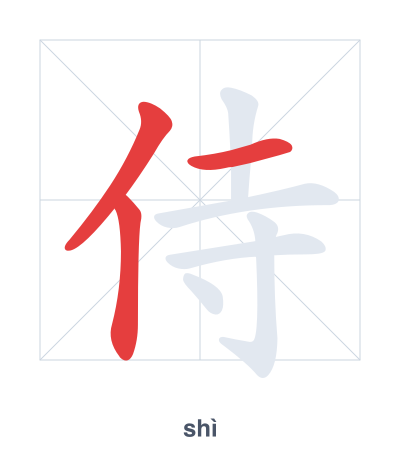
Open Hanzi Writer to see the animated stroke order and practice writing 侍 with real-time feedback.
The character 侍 (shì) is written with 8 strokes. Follow the standard Chinese stroke order: top to bottom, left to right, outside before inside. The radical 亻 is one of its key components.
Practice the correct stroke order with the Hanzi Writer app to see animated stroke-by-stroke guidance with real-time feedback.
侍 means to serve; to attend to.
As an HSK Level 7 character, 侍 is an intermediate-level character.
侍 combines the radical 亻 (person) with 寺 (temple or government office), indicating a person who serves at a temple or official establishment. In ancient China, 侍 referred to attendants or servants who waited upon nobles or deities, reflecting the role of standing ready in a formal setting.
💡 Memory Tip: Imagine a person (亻) standing politely beside a temple (寺), ready to serve tea to the monks.
这里的侍者很有礼貌。
zhè lǐ de shì zhě hěn yǒu lǐ mào
The waiters here are very polite.
他在侍候生病的奶奶。
tā zài shì hòu shēng bìng de nǎi nǎi
He is attending to his sick grandmother.
护士在服侍病人。
hù shì zài fú shì bìng rén
The nurse is attending to the patient.
Open Hanzi Writer to see the animated stroke order and practice writing 侍 with real-time feedback.
✨ Animated stroke order · Handwriting recognition · HSK-graded practice · Free to use
侍 is composed of the radical 亻 (person) on the left and 寺 (temple) on the right. This structure suggests a person serving at a temple, linking directly to the meaning "to serve" or "to attend to."