涉 (shè) means "to wade; to involve; to experience" in Chinese. It has 10 strokes with the radical 氵, and is HSK Level 6.
Rated 4.2/5 in difficulty (advanced).
Harder than 73% of HSK Level 6 characters.
Appears in 3+ common words including 涉及 (shè jí), 涉外 (shè wài), 干涉 (gān shè).
Due to its 10 strokes, Hanzi Writer's error detection shows 涉 requires focused practice — most learners need 10+ attempts for consistent accuracy.
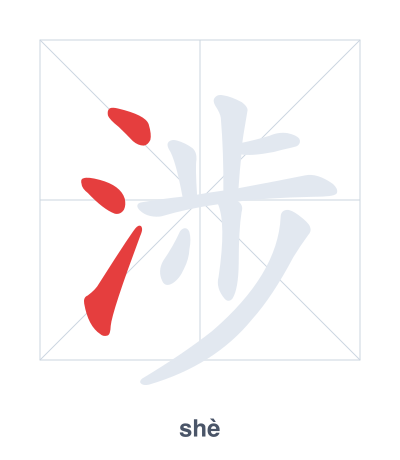
Open Hanzi Writer to see the animated stroke order and practice writing 涉 with real-time feedback.
The character 涉 (shè) is written with 10 strokes. Follow the standard Chinese stroke order: top to bottom, left to right, outside before inside. The radical 氵 is one of its key components.
Practice the correct stroke order with the Hanzi Writer app to see animated stroke-by-stroke guidance with real-time feedback.
涉 means to wade; to involve; to experience.
As an HSK Level 6 character, 涉 is an intermediate-level character.
涉 combines the water radical 氵 (river) with 步 (step). The ancient form shows a person stepping through water, literally 'to wade'. This action of crossing water extended metaphorically to 'to involve' and 'to experience'.
💡 Memory Tip: Picture three drops of water (氵) on a path, and as you step in them (步), you wade into the situation.
这个问题涉及隐私。
zhè ge wèn tí shè jí yǐn sī
This issue involves privacy.
他在涉外酒店工作。
tā zài shè wài jiǔ diàn gōng zuò
He works in a hotel that caters to foreigners.
请不要干涉我的生活。
qǐng bú yào gān shè wǒ de shēng huó
Please don't interfere in my life.
Open Hanzi Writer to see the animated stroke order and practice writing 涉 with real-time feedback.
✨ Animated stroke order · Handwriting recognition · HSK-graded practice · Free to use
涉 is made of the water radical 氵 on the left and the character 步 (meaning 'step' or 'walk') on the right. The water plus steps together suggest wading through water, which is the original meaning. This also led to extended meanings like 'to involve' because stepping into something can imply being part of it.