醛 (quán) means "aldehyde" in Chinese. It has 16 strokes with the radical 酉.
Rated 4.2/5 in difficulty (advanced).
Appears in 3+ common words including 甲醛 (jiǎ quán), 醛类 (quán lèi), 乙醛 (yǐ quán).
Due to its 16 strokes, Hanzi Writer's error detection shows 醛 requires focused practice — most learners need 10+ attempts for consistent accuracy.
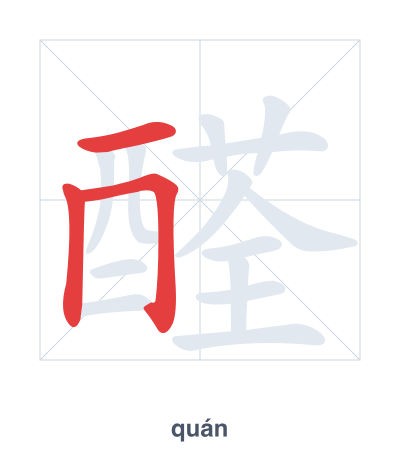
Open Hanzi Writer to see the animated stroke order and practice writing 醛 with real-time feedback.
The character 醛 (quán) is written with 16 strokes. Follow the standard Chinese stroke order: top to bottom, left to right, outside before inside. The radical 酉 is one of its key components.
Practice the correct stroke order with the Hanzi Writer app to see animated stroke-by-stroke guidance with real-time feedback.
醛 means aldehyde.
醛 is a phono-semantic compound. The radical 酉 (wine jar) links to alcohol and fermentation, as aldehydes are often derived from alcohol oxidation. The component 荃 (quán, 'fragrant herb') provides the sound and hints at the strong, sometimes pungent odors typical of aldehydes.
💡 Memory Tip: Imagine a wine vat (酉) filled with fragrant herbs (荃) that have oxidized into a sharp-smelling aldehyde, making you wrinkle your nose.
新房子里有甲醛。
xīn fáng zi lǐ yǒu jiǎ quán
There is formaldehyde in the new house.
这是常见的醛类物质。
zhè shì cháng jiàn de quán lèi wù zhì
These are common aldehydes.
乙醛是一种化学物质。
yǐ quán shì yī zhǒng huà xué wù zhì
Acetaldehyde is a chemical substance.
Open Hanzi Writer to see the animated stroke order and practice writing 醛 with real-time feedback.
✨ Animated stroke order · Handwriting recognition · HSK-graded practice · Free to use
The character 醛 combines the radical 酉 (yǒu, related to fermentation or wine) on the left and 荃 (quán, a phonetic component) on the right. The 酉 radical connects it to chemical compounds, especially those found in wine or fermentation, while 荃 provides the pronunciation quán, together indicating an organic compound called aldehyde.