玷 (diàn) means "flaw / blemish" in Chinese. It has 9 strokes with the radical 王.
Rated 4/5 in difficulty (challenging).
Appears in 3+ common words including 玷污 (diàn wū), 玷辱 (diàn rǔ), 瑕玷 (xiá diàn).
Due to its 9 strokes, Hanzi Writer's error detection shows 玷 requires focused practice — most learners need 10+ attempts for consistent accuracy.
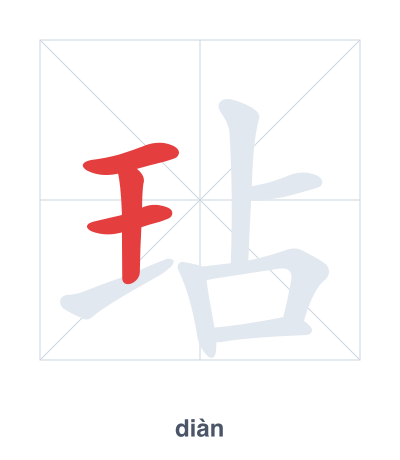
Open Hanzi Writer to see the animated stroke order and practice writing 玷 with real-time feedback.
The character 玷 (diàn) is written with 9 strokes. Follow the standard Chinese stroke order: top to bottom, left to right, outside before inside. The radical 王 is one of its key components.
Practice the correct stroke order with the Hanzi Writer app to see animated stroke-by-stroke guidance with real-time feedback.
玷 means flaw / blemish.
玷 combines 王 (jade) with 占 (to occupy/divine). The character originally meant a flaw or spot on jade, as if a blemish 'occupies' the precious stone's surface.
💡 Memory Tip: Picture a flawless jade disk (王) with a dark spot (the dot of 占) staining it like a permanent blemish.
别玷污了白衬衫。
bié diàn wū le bái chèn shān
Don't stain the white shirt.
这是一种玷辱。
zhè shì yī zhǒng diàn rǔ
This is a type of disgrace.
这块玉没有瑕玷。
zhè kuài yù méi yǒu xiá diàn
This jade has no flaws.
Open Hanzi Writer to see the animated stroke order and practice writing 玷 with real-time feedback.
✨ Animated stroke order · Handwriting recognition · HSK-graded practice · Free to use
玷 is composed of the radical 王 (jade) on the left and the phonetic component 占 (zhàn) on the right. The jade radical hints that the character originally related to flaws in jade, which extends to mean any blemish or defect. The phonetic component suggests the pronunciation diàn, though it is not exact.