玳 (dài) means "tortoiseshell" in Chinese. It has 9 strokes with the radical 王.
Rated 4/5 in difficulty (challenging).
Appears in 3+ common words including 玳瑁 (dài mào), 玳瑁猫 (dài mào māo), 玳筵 (dài yán).
Due to its 9 strokes, Hanzi Writer's error detection shows 玳 requires focused practice — most learners need 10+ attempts for consistent accuracy.
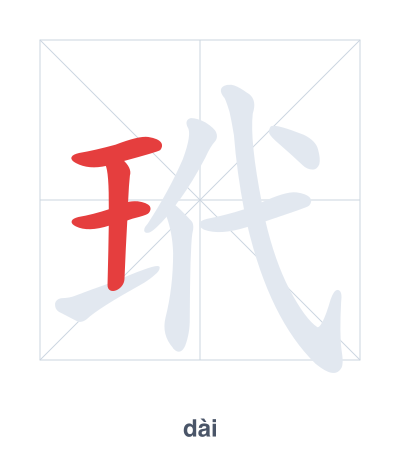
Open Hanzi Writer to see the animated stroke order and practice writing 玳 with real-time feedback.
The character 玳 (dài) is written with 9 strokes. Follow the standard Chinese stroke order: top to bottom, left to right, outside before inside. The radical 王 is one of its key components.
Practice the correct stroke order with the Hanzi Writer app to see animated stroke-by-stroke guidance with real-time feedback.
玳 means tortoiseshell.
玳 is a phono-semantic compound where the radical 王 (jade) signifies a precious material, and 代 (dài) provides the pronunciation. Tortoiseshell was prized like jade for ornamentation, so the character links the idea of a valuable substance with its phonetic cue.
💡 Memory Tip: Imagine a jade (王) pendant that has been passed down for generations (代), but the pattern on it is actually a tortoiseshell design.
他戴着玳瑁眼镜。
tā dài zhe dài mào yǎn jìng
He is wearing tortoiseshell glasses.
我家养了一只玳瑁猫。
wǒ jiā yǎng le yī zhī dài mào māo
I have a tortoiseshell cat.
他们在参加玳筵。
tā men zài cān jiā dài yán
They are attending a grand banquet.
Open Hanzi Writer to see the animated stroke order and practice writing 玳 with real-time feedback.
✨ Animated stroke order · Handwriting recognition · HSK-graded practice · Free to use
The character 玳 is made of the radical 王 (jade) on the left and the phonetic component 代 (dài, meaning 'substitute' or 'generation') on the right. The radical 王 indicates that the character relates to precious materials, which matches tortoiseshell as a valuable decorative material. The right side 代 gives the pronunciation and has no direct connection to the meaning.