箝 (qián) means "pliers / to clamp / to gag" in Chinese. It has 14 strokes with the radical 竹.
Rated 4.2/5 in difficulty (advanced).
Appears in 3+ common words including 箝制 (qián zhì), 箝口 (qián kǒu), 箝夹 (qián jiā).
Due to its 14 strokes, Hanzi Writer's error detection shows 箝 requires focused practice — most learners need 10+ attempts for consistent accuracy.
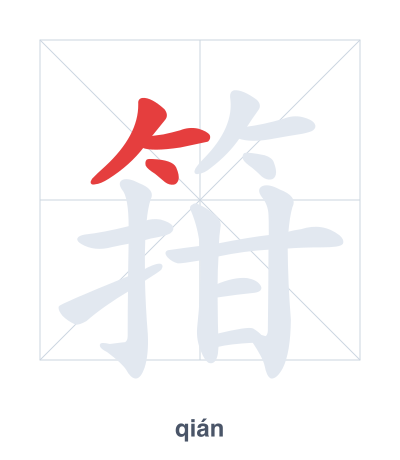
Open Hanzi Writer to see the animated stroke order and practice writing 箝 with real-time feedback.
The character 箝 (qián) is written with 14 strokes. Follow the standard Chinese stroke order: top to bottom, left to right, outside before inside. The radical 竹 is one of its key components.
Practice the correct stroke order with the Hanzi Writer app to see animated stroke-by-stroke guidance with real-time feedback.
箝 means pliers / to clamp / to gag.
箝 combines bamboo (竹) with 甘 (sweet, originally a pictograph of a mouth with something sweet), symbolizing a bamboo implement used to clamp or gag the mouth. The lower component 甘 provides phonetic clues and semantic association with the mouth. This compound character thus depicts the action of using a bamboo tool to pinch or restrain.
💡 Memory Tip: Picture a bamboo (竹) clamp holding a sweet (甘) candy tight, like pliers pinching shut.
他的思想受到了箝制。
tā de sī xiǎng shòu dào le qián zhì
His thoughts were suppressed.
大家都箝口不言。
dà jiā dōu qián kǒu bù yán
Everyone kept their mouths shut.
用竹夹子箝夹东西。
yòng zhú jiā zi qián jiā dōng xī
Use bamboo tongs to grip things.
Open Hanzi Writer to see the animated stroke order and practice writing 箝 with real-time feedback.
✨ Animated stroke order · Handwriting recognition · HSK-graded practice · Free to use
箝 uses the radical 竹 (bamboo) on top, suggesting the object is made of bamboo. The lower part is 拑, which is a phonetic component meaning "clamp" or "pliers." Together, the character represents a bamboo tool used for clamping or gagging.