漆 (qī) means "Paint / Lacquer" in Chinese. It has 14 strokes with the radical 氵, and is HSK Level 7.
Rated 4.2/5 in difficulty (advanced).
Harder than 69% of HSK Level 7 characters.
Appears in 3+ common words including 油漆 (yóu qī), 漆黑 (qī hēi), 喷漆 (pēn qī).
Due to its 14 strokes, Hanzi Writer's error detection shows 漆 requires focused practice — most learners need 10+ attempts for consistent accuracy.
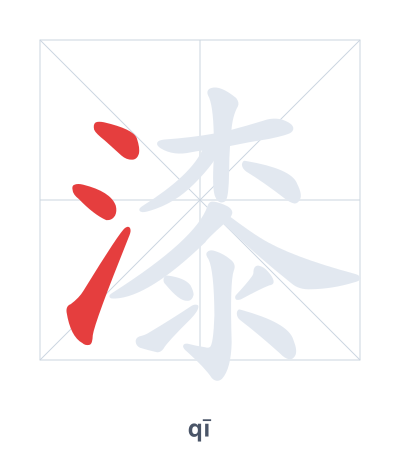
Open Hanzi Writer to see the animated stroke order and practice writing 漆 with real-time feedback.
The character 漆 (qī) is written with 14 strokes. Follow the standard Chinese stroke order: top to bottom, left to right, outside before inside. The radical 氵 is one of its key components.
Practice the correct stroke order with the Hanzi Writer app to see animated stroke-by-stroke guidance with real-time feedback.
漆 means Paint / Lacquer.
As an HSK Level 7 character, 漆 is an intermediate-level character.
漆 combines the water radical 氵 with 桼 (qī), an ancient pictograph of a lacquer tree dripping sap, so the character originally depicted tree sap mixed with water to form paint or lacquer.
💡 Memory Tip: Imagine a tree (木) with sap dripping into water (氵) and a man (亻) stirring it to make paint—the top part 桼 looks like a tree with drops.
椅子上的油漆还没干。
yǐ zi shàng de yóu qī hái méi gàn
The paint on the chair is not dry yet.
外面漆黑一片。
wài miàn qī hēi yī piàn
It is pitch black outside.
工人在给这台旧机器喷漆,让它焕然一新。
gōng rén zài gěi zhè tái jiù jī qì pēn qī , ràng tā huàn rán yì xīn 。
The worker is spray-painting this old machine to make it look brand new.
Open Hanzi Writer to see the animated stroke order and practice writing 漆 with real-time feedback.
✨ Animated stroke order · Handwriting recognition · HSK-graded practice · Free to use
漆 is composed of the water radical 氵 on the left and the phonetic component 桼 on the right. The water radical hints that lacquer is a liquid, while 桼 originally depicted sap from the lacquer tree, so together they represent the liquid substance used for painting.