渣 (zhā) means "Residue or dregs" in Chinese. It has 12 strokes with the radical 氵, and is HSK Level 7.
Rated 4.2/5 in difficulty (advanced).
Harder than 67% of HSK Level 7 characters.
Appears in 3+ common words including 渣子 (zhā zi), 豆腐渣 (dòu fǔ zhā), 残渣 (cán zhā).
Due to its 12 strokes, Hanzi Writer's error detection shows 渣 requires focused practice — most learners need 10+ attempts for consistent accuracy.
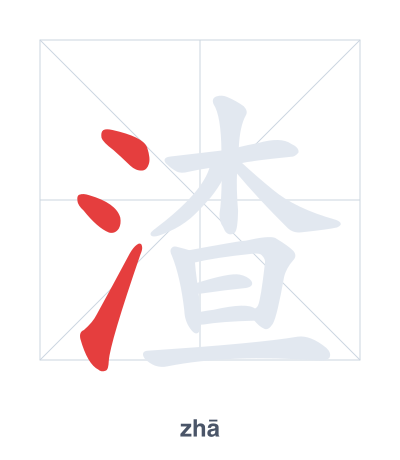
Open Hanzi Writer to see the animated stroke order and practice writing 渣 with real-time feedback.
The character 渣 (zhā) is written with 12 strokes. Follow the standard Chinese stroke order: top to bottom, left to right, outside before inside. The radical 氵 is one of its key components.
Practice the correct stroke order with the Hanzi Writer app to see animated stroke-by-stroke guidance with real-time feedback.
渣 means Residue or dregs.
As an HSK Level 7 character, 渣 is an intermediate-level character.
渣 is a phono-semantic compound: the water radical (氵) indicates liquid, while 查 (zhā) provides pronunciation and subtly conveys the idea of inspecting or sifting, leaving behind unwanted residue.
💡 Memory Tip: Picture water (氵) filtering through a wooden block (木) under the hot sun (日), leaving a sticky, dirty residue behind.
杯子里有渣子。
bēi zi lǐ yǒu zhā zi
There is residue in the cup.
豆腐渣可以吃。
dòu fǔ zhā kě yǐ chī
Tofu dregs are edible.
清理掉这些残渣。
qīng lǐ diào zhè xiē cán zhā
Clean up these residues.
Open Hanzi Writer to see the animated stroke order and practice writing 渣 with real-time feedback.
✨ Animated stroke order · Handwriting recognition · HSK-graded practice · Free to use
渣 is made of the water radical 氵 on the left and the phonetic component 查 (chá, to examine) on the right. The water radical hints that dregs often settle out of liquids, while 查 provides sound and reminds us of checking for leftover bits.