噢 (ō) means "oh (expressing realization)" in Chinese. It has 15 strokes with the radical 口.
Rated 4.2/5 in difficulty (advanced).
Appears in 3+ common words including 噢,我知道了 (ō wǒ zhī dào le), 噢,原来如此 (ō yuán lái rú cǐ), 噢,对不起 (ō duì bù qǐ).
Due to its 15 strokes, Hanzi Writer's error detection shows 噢 requires focused practice — most learners need 10+ attempts for consistent accuracy.
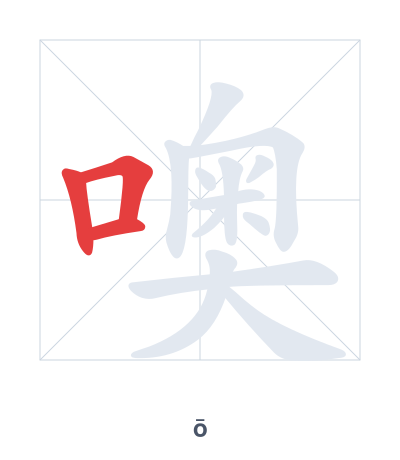
Open Hanzi Writer to see the animated stroke order and practice writing 噢 with real-time feedback.
The character 噢 (ō) is written with 15 strokes. Follow the standard Chinese stroke order: top to bottom, left to right, outside before inside. The radical 口 is one of its key components.
Practice the correct stroke order with the Hanzi Writer app to see animated stroke-by-stroke guidance with real-time feedback.
噢 means oh (expressing realization).
噢 is a compound character with the mouth radical 口 (kǒu) indicating spoken sound, and the phonetic component 奥 (ào) meaning 'deep' or 'profound'. The character imitates the exclamation "oh" when one suddenly understands something deep or hidden.
💡 Memory Tip: Picture a mouth (口) opening wide in an "O" shape as you suddenly realize you've unlocked a deep secret (奥), making you say "Oh!"
噢,我知道了。
ō wǒ zhī dào le
Oh, I see.
噢,原来如此。
ō yuán lái rú cǐ
Oh, I see.
噢,对不起,我忘了。
ō duì bù qǐ wǒ wàng le
Oh, sorry, I forgot.
Open Hanzi Writer to see the animated stroke order and practice writing 噢 with real-time feedback.
✨ Animated stroke order · Handwriting recognition · HSK-graded practice · Free to use
噢 is composed of the radical 口 (mouth) on the left and the phonetic component 奥 on the right. The 口 radical indicates that the character is related to sounds or speech, while 奥 provides the pronunciation ō. Together, they form an exclamation sound made with the mouth.