捏 (niē) means "to pinch or mold" in Chinese. It has 10 strokes with the radical 扌, and is HSK Level 7.
Rated 4.2/5 in difficulty (advanced).
Harder than 58% of HSK Level 7 characters.
Appears in 3+ common words including 捏饺子 (niē jiǎo zi), 捏一捏 (niē yī niē), 捏泥人 (niē ní rén).
Due to its 10 strokes, Hanzi Writer's error detection shows 捏 requires focused practice — most learners need 10+ attempts for consistent accuracy.
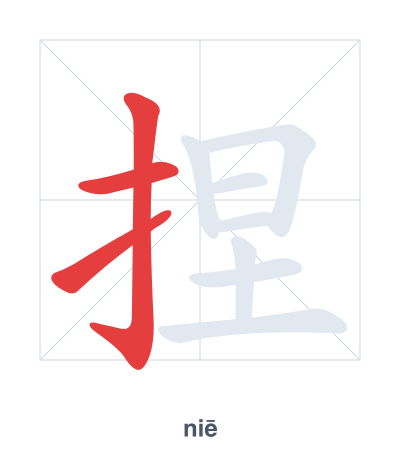
Open Hanzi Writer to see the animated stroke order and practice writing 捏 with real-time feedback.
The character 捏 (niē) is written with 10 strokes. Follow the standard Chinese stroke order: top to bottom, left to right, outside before inside. The radical 扌 is one of its key components.
Practice the correct stroke order with the Hanzi Writer app to see animated stroke-by-stroke guidance with real-time feedback.
捏 means to pinch or mold.
As an HSK Level 7 character, 捏 is an intermediate-level character.
捏 combines the hand radical 扌 (meaning action with hands) with the phonetic component 圼 (rì + tǔ, indicating sound but also evoking earth and sun). Together they suggest using fingers to pinch and mold pliable material like clay or dough.
💡 Memory Tip: Imagine your hand (扌) pinching a lump of soil (土) under a blazing sun (日) to shape it into a tiny sculpture.
我们一起捏饺子。
wǒ men yì qǐ niē jiǎo zi
Let's make dumplings together.
捏一捏这个玩具。
niē yī niē zhè ge wán jù
Give this toy a squeeze.
小朋友在捏泥人。
xiǎo péng yǒu zài niē ní rén
The child is molding clay figures.
Open Hanzi Writer to see the animated stroke order and practice writing 捏 with real-time feedback.
✨ Animated stroke order · Handwriting recognition · HSK-graded practice · Free to use
The character 捏 has the hand radical 扌 on the left, showing it is a hand action. The right side is made of 日 (sun) and 土 (earth or soil), which together suggest working with clay or dough using your hands to pinch and mold.