腻 (nì) means "greasy or oily" in Chinese. It has 13 strokes with the radical 月, and is HSK Level 7.
Rated 4.2/5 in difficulty (advanced).
Harder than 84% of HSK Level 7 characters.
Appears in 3+ common words including 油腻 (yóu nì), 腻了 (nì le), 细腻 (xì nì).
Due to its 13 strokes, Hanzi Writer's error detection shows 腻 requires focused practice — most learners need 10+ attempts for consistent accuracy.
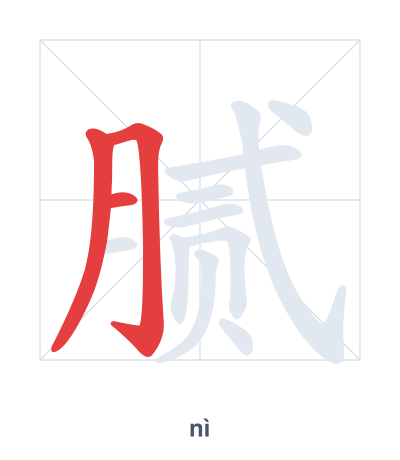
Open Hanzi Writer to see the animated stroke order and practice writing 腻 with real-time feedback.
The character 腻 (nì) is written with 13 strokes. Follow the standard Chinese stroke order: top to bottom, left to right, outside before inside. The radical 月 is one of its key components.
Practice the correct stroke order with the Hanzi Writer app to see animated stroke-by-stroke guidance with real-time feedback.
腻 means greasy or oily.
As an HSK Level 7 character, 腻 is an intermediate-level character.
The character 腻 combines the radical 月 (meat) with 贰 (two), suggesting an excess of fat or oil. It originally referred to the greasy texture of fatty meat, where the doubled element implies an overabundance of grease.
💡 Memory Tip: Picture a slab of meat (月) so greasy that when you grab it, two (贰) oily handprints appear on your fingers.
炸鸡太油腻了。
zhà jī tài yóu nì le
Fried chicken is too greasy.
这首歌听腻了。
zhè shǒu gē tīng nì le
I'm tired of listening to this song.
皮肤很细腻。
pí fū hěn xì nì
The skin is very smooth and delicate.
Open Hanzi Writer to see the animated stroke order and practice writing 腻 with real-time feedback.
✨ Animated stroke order · Handwriting recognition · HSK-graded practice · Free to use
腻 has the left radical 月 (meat/flesh) and the right part 贰 (which means 'two' but here indicates sound). The meat radical suggests something related to fat or flesh, hinting at the greasy or oily meaning.