挠 (náo) means "scratch; hinder" in Chinese. It has 9 strokes with the radical 扌, and is HSK Level 7.
Rated 4/5 in difficulty (challenging).
Harder than 41% of HSK Level 7 characters.
Appears in 3+ common words including 挠头 (náo tóu), 挠痒 (náo yǎng), 阻挠 (zǔ náo).
Due to its 9 strokes, Hanzi Writer's error detection shows 挠 requires focused practice — most learners need 10+ attempts for consistent accuracy.
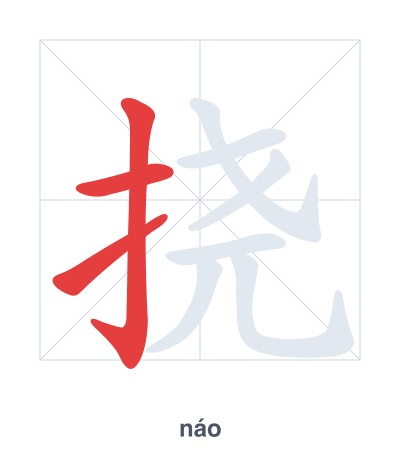
Open Hanzi Writer to see the animated stroke order and practice writing 挠 with real-time feedback.
The character 挠 (náo) is written with 9 strokes. Follow the standard Chinese stroke order: top to bottom, left to right, outside before inside. The radical 扌 is one of its key components.
Practice the correct stroke order with the Hanzi Writer app to see animated stroke-by-stroke guidance with real-time feedback.
挠 means scratch; hinder.
As an HSK Level 7 character, 挠 is an intermediate-level character.
挠 is a phono-semantic compound: the hand radical (扌) suggests an action, while 尧 (yáo) provides the sound. The character originally meant 'to scratch' as with the hand, and later extended to 'to hinder' by implying a disruptive action.
💡 Memory Tip: Imagine a hand (扌) scratching the head of the legendary emperor Yao (尧) in frustration, causing him to be hindered.
这个问题让人挠头。
zhè ge wèn tí ràng rén náo tóu
This problem is a real head-scratcher.
我帮猫挠痒。
wǒ bāng māo náo yǎng
I'm scratching the cat's itch.
计划受到了阻挠。
jì huà shòu dào le zǔ náo
The plan was obstructed.
Open Hanzi Writer to see the animated stroke order and practice writing 挠 with real-time feedback.
✨ Animated stroke order · Handwriting recognition · HSK-graded practice · Free to use
挠 is a left-right character. The left side is the radical 扌, which means hand, showing the action is done by hand. The right side is 尧 (yáo), which acts as a phonetic component hinting at the pronunciation.