耐 (nài) means "To endure / Patient" in Chinese. It has 9 strokes with the radical 而, and is HSK Level 5.
Rated 4/5 in difficulty (challenging).
Harder than 57% of HSK Level 5 characters.
Appears in 3+ common words including 耐心 (nài xīn), 耐用 (nài yòng), 耐热 (nài rè).
Due to its 9 strokes, Hanzi Writer's error detection shows 耐 requires focused practice — most learners need 10+ attempts for consistent accuracy.
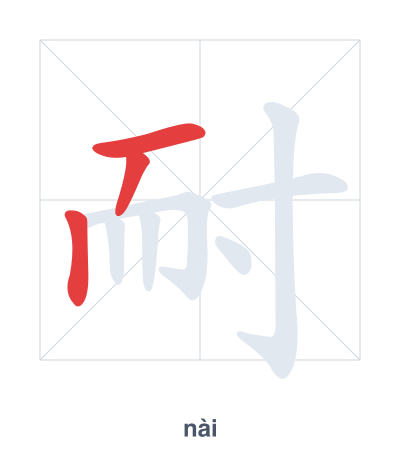
Open Hanzi Writer to see the animated stroke order and practice writing 耐 with real-time feedback.
The character 耐 (nài) is written with 9 strokes. Follow the standard Chinese stroke order: top to bottom, left to right, outside before inside. The radical 而 is one of its key components.
Practice the correct stroke order with the Hanzi Writer app to see animated stroke-by-stroke guidance with real-time feedback.
耐 means To endure / Patient.
As an HSK Level 5 character, 耐 is an intermediate-level character.
耐 originally depicted the punishment of shaving a man's beard, with 而 (beard) and 寸 (hand) showing the action. Over time it came to mean enduring or being patient, as one must tolerate the discomfort.
💡 Memory Tip: Imagine a person with a beard (而) using their hand (寸) to pull it out slowly, enduring the pain.
老师很有耐心。
lǎo shī hěn yǒu nài xīn
The teacher is very patient.
这双鞋非常耐用。
zhè shuāng xié fēi cháng nài yòng
These shoes are very durable.
这种材料很耐热。
zhè zhǒng cái liào hěn nài rè
This material is very heat-resistant.
Open Hanzi Writer to see the animated stroke order and practice writing 耐 with real-time feedback.
✨ Animated stroke order · Handwriting recognition · HSK-graded practice · Free to use
The character 耐 is composed of two parts: the top part 而 (ér) and the bottom part 寸 (cùn, meaning 'hand' or 'measure'). Together, they suggest holding on firmly with a hand, which represents enduring or being patient. The top 而 originally depicted a beard or hanging object, but here it adds a sense of steadiness.