耑 (duān) means "Origin / End / Upright" in Chinese. It has 9 strokes with the radical 而.
Rated 4/5 in difficulty (challenging).
Appears in 3+ common words including 耑此 (duān cǐ), 耑正 (duān zhèng), 耑委 (duān wěi).
Due to its 9 strokes, Hanzi Writer's error detection shows 耑 requires focused practice — most learners need 10+ attempts for consistent accuracy.
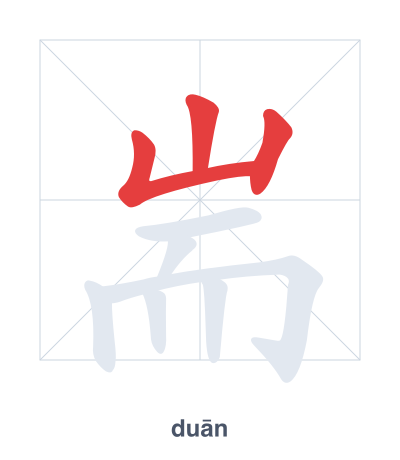
Open Hanzi Writer to see the animated stroke order and practice writing 耑 with real-time feedback.
The character 耑 (duān) is written with 9 strokes. Follow the standard Chinese stroke order: top to bottom, left to right, outside before inside. The radical 而 is one of its key components.
Practice the correct stroke order with the Hanzi Writer app to see animated stroke-by-stroke guidance with real-time feedback.
耑 means Origin / End / Upright.
| Character | 耑 |
| Pinyin | duān (duan) |
| Meaning | Origin / End / Upright |
| Strokes | 9 |
| Radical | 而 |
| Difficulty | 4/5 |
耑 was originally a pictograph of a plant sprouting from the ground, with roots below and shoots above, symbolizing both the origin (where growth begins) and the end (the tip of the sprout). Its upright posture led to the meaning of 'upright' or 'correct.' The modern form preserves the top sprout shape and a lower root-like structure, though the radical 而 (beard) is a later simplification.
💡 Memory Tip: Imagine a plant with two tiny leaves at the top (the top strokes) and deep roots at the bottom (the lower strokes) standing perfectly straight—its very origin and end are in that upright posture.
耑此奉达。
duān cǐ fèng dá
I am writing this specifically to inform you.
办事要耑正。
bàn shì yào duān zhèng
One should be upright in handling affairs.
细说其耑委。
xì shuō qí duān wěi
Explain the whole story in detail.
Open Hanzi Writer to see the animated stroke order and practice writing 耑 with real-time feedback.
✨ Animated stroke order · Handwriting recognition · HSK-graded practice · Free to use
耑 is made of a top part that looks like a mountain (山) and a bottom part 而 (beard). Together they symbolize the two extremes of a plant—the tip (end) and the root (origin), which connects to its meanings of origin, end, and upright.