睦 (mù) means "Harmonious." in Chinese. It has 13 strokes with the radical 目, and is HSK Level 7.
Rated 4.2/5 in difficulty (advanced).
Harder than 74% of HSK Level 7 characters.
Appears in 3+ common words including 和睦 (hé mù), 邻里和睦 (lín lǐ hé mù), 睦邻 (mù lín).
Due to its 13 strokes, Hanzi Writer's error detection shows 睦 requires focused practice — most learners need 10+ attempts for consistent accuracy.
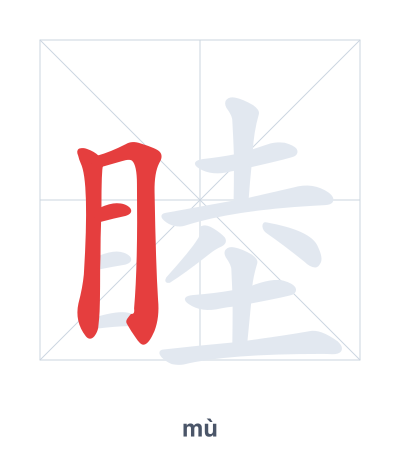
Open Hanzi Writer to see the animated stroke order and practice writing 睦 with real-time feedback.
The character 睦 (mù) is written with 13 strokes. Follow the standard Chinese stroke order: top to bottom, left to right, outside before inside. The radical 目 is one of its key components.
Practice the correct stroke order with the Hanzi Writer app to see animated stroke-by-stroke guidance with real-time feedback.
睦 means Harmonious..
As an HSK Level 7 character, 睦 is an intermediate-level character.
睦 combines the eye radical (目), suggesting a friendly gaze, with the phonetic component 坴 (lù). Originally it evoked the visual expression of mutual respect and harmony between people, as seen in their eyes.
💡 Memory Tip: Picture two eyes (目) gazing warmly over a little mound of earth (坴) — that shared peaceful look is harmony.
他们家很和睦。
tā men jiā hěn hé mù
Their family is very harmonious.
邻里要和睦。
lín lǐ yào hé mù
Neighbors should live in harmony.
睦邻友好很重要。
mù lín yǒu hǎo hěn zhòng yào
Good-neighborly relations are very important.
Open Hanzi Writer to see the animated stroke order and practice writing 睦 with real-time feedback.
✨ Animated stroke order · Handwriting recognition · HSK-graded practice · Free to use
睦 has two parts: the left radical 目 (eye) and the right component 坔 (made of 土 earth and 八 eight). The eye suggests that harmony comes from how we see others, while the right side provides the sound mù. Together, the character visually hints at many people (eight) on the same ground living in harmony.