瘼 (mò) means "sickness or suffering of the people" in Chinese. It has 15 strokes with the radical 疒.
Rated 4.2/5 in difficulty (advanced).
Appears in 3+ common words including 民瘼 (mín mò), 察民瘼 (chá mín mò), 恤民瘼 (xù mín mò).
Due to its 15 strokes, Hanzi Writer's error detection shows 瘼 requires focused practice — most learners need 10+ attempts for consistent accuracy.
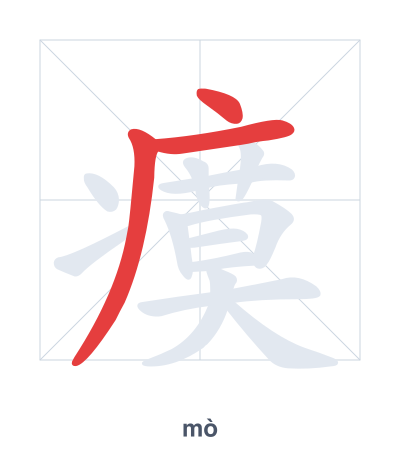
Open Hanzi Writer to see the animated stroke order and practice writing 瘼 with real-time feedback.
The character 瘼 (mò) is written with 15 strokes. Follow the standard Chinese stroke order: top to bottom, left to right, outside before inside. The radical 疒 is one of its key components.
Practice the correct stroke order with the Hanzi Writer app to see animated stroke-by-stroke guidance with real-time feedback.
瘼 means sickness or suffering of the people.
瘼 is a compound character formed with the radical 疒 (illness) and the phonetic component 莫 (mò, meaning 'none' or 'sunset'). The radical indicates the meaning relates to sickness, while 莫 provides the sound, together signifying widespread suffering or affliction of the people.
💡 Memory Tip: Picture a crowd of people under a setting sun (莫) all lying sick in beds (疒), their suffering spreading like a dark cloud.
官员要关心民瘼。
guān yuán yào guān xīn mín mò
Officials should care about the people's hardships.
他下乡去察民瘼。
tā xià xiāng qù chá mín mò
He went to the countryside to investigate the people's suffering.
政府应当恤民瘼。
zhèng fǔ yīng dāng xù mín mò
The government should care for the people's hardships.
Open Hanzi Writer to see the animated stroke order and practice writing 瘼 with real-time feedback.
✨ Animated stroke order · Handwriting recognition · HSK-graded practice · Free to use
The character 瘼 is made of two parts: the radical 疒 on the left, which means illness, and 莫 on the right, which provides sound and also carries a sense of "none" or "not." Together, 瘼 suggests a sickness or suffering that is widespread among the people, like a hardship that leaves nothing untouched.