旲 (tái) means "great; big (archaic)" in Chinese. It has 7 strokes with the radical 日.
Rated 3.5/5 in difficulty (challenging).
Appears in 3+ common words including 旲旲 (tái tái), 旲公 (tái gōng), 旲阳 (tái yáng).
Due to its 7 strokes, Hanzi Writer's error detection shows 旲 requires focused practice — most learners need 10+ attempts for consistent accuracy.
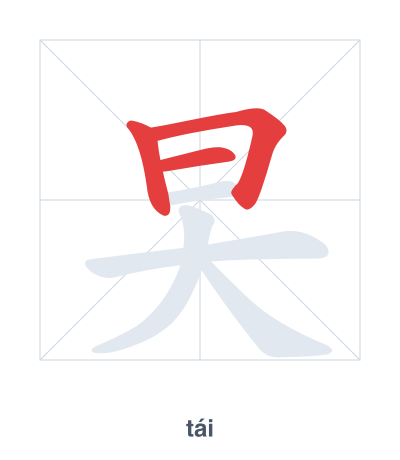
Open Hanzi Writer to see the animated stroke order and practice writing 旲 with real-time feedback.
The character 旲 (tái) is written with 7 strokes. Follow the standard Chinese stroke order: top to bottom, left to right, outside before inside. The radical 日 is one of its key components.
Practice the correct stroke order with the Hanzi Writer app to see animated stroke-by-stroke guidance with real-time feedback.
旲 means great; big (archaic).
The character 旲 is a compound of 日 (sun) above 大 (big), visually suggesting the sun's vastness—hence its archaic meaning 'great' or 'big'. It likely originated as an ideogram where the sun's size was emphasized by the large component below.
💡 Memory Tip: Picture a giant sun (日) blazing over a huge 'big' person (大) standing below, making everything look immensely great.
阳光旲旲。
yáng guāng tái tái
The sunlight is bright and vast.
他被称为旲公。
tā bèi chēng wéi tái gōng
He was called Lord Tai.
旲阳之气很足。
tái yáng zhī qì hěn zú
The solar energy is very strong.
Open Hanzi Writer to see the animated stroke order and practice writing 旲 with real-time feedback.
✨ Animated stroke order · Handwriting recognition · HSK-graded practice · Free to use
旲 is composed of the radical 日 (sun) on top and 大 (big) below. The sun above something big suggests brightness or greatness, matching its archaic meaning of "great" or "big."