脉 (mài/mò) means "pulse; vein; mountain range" in Chinese. It has 9 strokes with the radical 月, and is HSK Level 7.
Rated 4/5 in difficulty (challenging).
Harder than 45% of HSK Level 7 characters.
Appears in 3+ common words including 山脉 (shān mài), 脉搏 (mài bó), 脉脉含情 (mò mò hán qíng).
Due to its 9 strokes, Hanzi Writer's error detection shows 脉 requires focused practice — most learners need 10+ attempts for consistent accuracy.
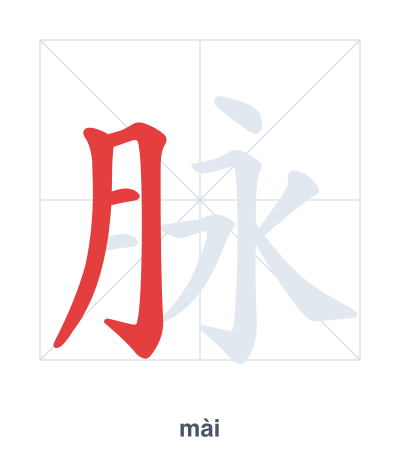
Open Hanzi Writer to see the animated stroke order and practice writing 脉 with real-time feedback.
The character 脉 (mài/mò) is written with 9 strokes. Follow the standard Chinese stroke order: top to bottom, left to right, outside before inside. The radical 月 is one of its key components.
Practice the correct stroke order with the Hanzi Writer app to see animated stroke-by-stroke guidance with real-time feedback.
脉 means pulse; vein; mountain range.
This is a polyphonic character with readings: mài, mò.
As an HSK Level 7 character, 脉 is an intermediate-level character.
The character 脉 combines the flesh radical 月 (⺼), indicating the body, with 永 (yǒng) meaning 'eternal' or 'flowing,' evoking the continuous flow of blood through veins. It later extended to describe mountain ranges as the 'veins' of the earth.
💡 Memory Tip: Picture the flesh of your wrist (月) with a tiny eternal river (永) running through it—that's your pulse.
巍峨的喜马拉雅山脉横跨了数个国家。
wēi é de xǐ mǎ lā yǎ shān mài héng kuà le shù gè guó jiā
The majestic Himalayas span several countries.
医生按住病人的手腕,仔细观察脉搏。
yī shēng àn zhù bìng rén de shǒu wàn zǐ xì guān chá mài bó
The doctor pressed the patient's wrist and carefully observed the pulse.
两人深情对望,目光中流露出脉脉含情。
liǎng rén shēn qíng duì wàng mù guāng zhōng liú lù chū mò mò hán qíng
The two looked at each other affectionately, their eyes full of tender love.
Open Hanzi Writer to see the animated stroke order and practice writing 脉 with real-time feedback.
✨ Animated stroke order · Handwriting recognition · HSK-graded practice · Free to use
脉 has two parts: the left radical 月, which originally meant 'flesh' or 'body part,' and the right side 永, meaning 'long flow' or 'eternal.' Together, they suggest the idea of something flowing through the body, like blood in veins or energy in pulses.