箓 (lù) means "incantation / book of spells / register" in Chinese. It has 14 strokes with the radical 竹.
Rated 4.2/5 in difficulty (advanced).
Appears in 3+ common words including 符箓 (fú lù), 宝箓 (bǎo lù), 秘箓 (mì lù).
Due to its 14 strokes, Hanzi Writer's error detection shows 箓 requires focused practice — most learners need 10+ attempts for consistent accuracy.
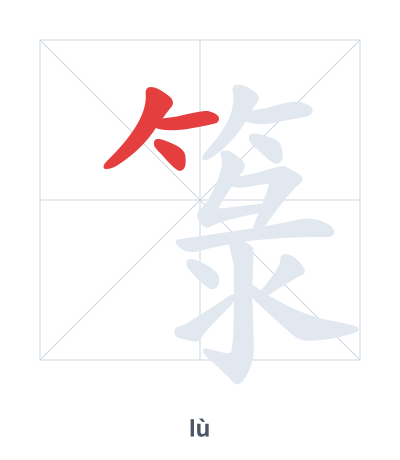
Open Hanzi Writer to see the animated stroke order and practice writing 箓 with real-time feedback.
The character 箓 (lù) is written with 14 strokes. Follow the standard Chinese stroke order: top to bottom, left to right, outside before inside. The radical 竹 is one of its key components.
Practice the correct stroke order with the Hanzi Writer app to see animated stroke-by-stroke guidance with real-time feedback.
箓 means incantation / book of spells / register.
箓 combines the radical 竹 (bamboo, referring to bamboo slips used for writing) with 录 (lù, meaning 'to record' or 'list'), indicating a written record on bamboo. Historically, such records included registers of names or ritual incantations, hence the meanings of 'register' and 'book of spells'.
💡 Memory Tip: Imagine a bamboo scroll (竹) inscribed with magical records (录), guarded by a wizard so that each character is a sacred spell.
墙上贴着一张符箓。
qiáng shàng tiē zhe yī zhāng fú lù
A talisman is pasted on the wall.
这是一本古代的宝箓。
zhè shì yī běn gǔ dài de bǎo lù
This is an ancient precious scripture.
他收藏了一卷秘箓。
tā shōu cáng le yī juàn mì lù
He collected a volume of secret records.
Open Hanzi Writer to see the animated stroke order and practice writing 箓 with real-time feedback.
✨ Animated stroke order · Handwriting recognition · HSK-graded practice · Free to use
箓 is made of the radical 竹 (bamboo) on top and the phonetic component 录 (record) below. Bamboo was used for writing slips in ancient China, so the character suggests a written record, specifically Taoist talismans or magical texts.