瘘 (lòu) means "fistula" in Chinese. It has 14 strokes with the radical 疒.
Rated 4.2/5 in difficulty (advanced).
Appears in 3+ common words including 痔瘘 (zhì lòu), 瘘管 (lòu guǎn), 颈瘘 (jǐng lòu).
Due to its 14 strokes, Hanzi Writer's error detection shows 瘘 requires focused practice — most learners need 10+ attempts for consistent accuracy.
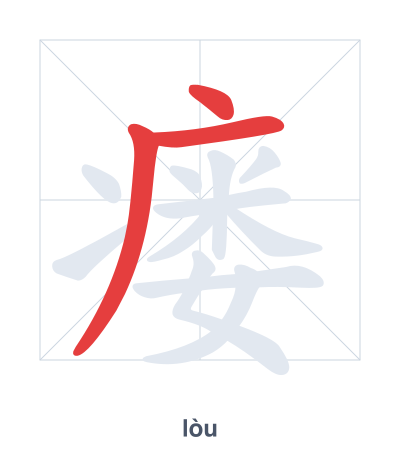
Open Hanzi Writer to see the animated stroke order and practice writing 瘘 with real-time feedback.
The character 瘘 (lòu) is written with 14 strokes. Follow the standard Chinese stroke order: top to bottom, left to right, outside before inside. The radical 疒 is one of its key components.
Practice the correct stroke order with the Hanzi Writer app to see animated stroke-by-stroke guidance with real-time feedback.
瘘 means fistula.
The character 瘘 combines the radical 疒 (illness) with 婁 (lóu), which originally depicted a hollow tube or conduit. This reflects a fistula as an abnormal, tubular passage caused by disease.
💡 Memory Tip: Imagine a sick person (疒) with a leaky pipe (婁 shaped like a tube) oozing pus from their side.
这种痔瘘需要手术。
zhè zhǒng zhì lòu xū yào shǒu shù
This anal fistula requires surgery.
医生在清理瘘管。
yī shēng zài qīng lǐ lòu guǎn
The doctor is cleaning the fistula.
他患有颈瘘。
tā huàn yǒu jǐng lòu
He suffers from a cervical fistula.
Open Hanzi Writer to see the animated stroke order and practice writing 瘘 with real-time feedback.
✨ Animated stroke order · Handwriting recognition · HSK-graded practice · Free to use
The left part is the radical 疒 (nè), meaning "sickness" or "disease." The right part is 娄 (lóu), which provides the sound and hints at something that leaks or drains. Together, they show a disease that creates an abnormal passage, like a fistula.