桲 (po) means "Quince" in Chinese. It has 11 strokes with the radical 木.
Rated 4.2/5 in difficulty (advanced).
Appears in 3+ common words including 榅桲 (wēn po), 榅桲果 (wēn po guǒ), 榅桲汁 (wēn po zhī).
Due to its 11 strokes, Hanzi Writer's error detection shows 桲 requires focused practice — most learners need 10+ attempts for consistent accuracy.
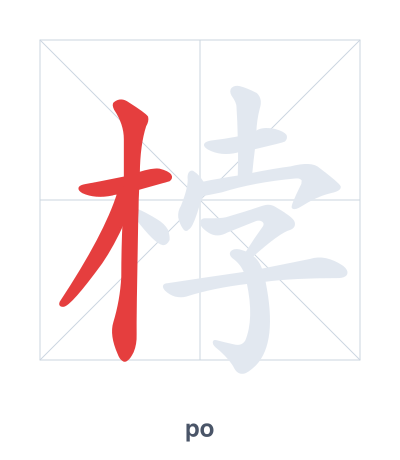
Open Hanzi Writer to see the animated stroke order and practice writing 桲 with real-time feedback.
The character 桲 (po) is written with 11 strokes. Follow the standard Chinese stroke order: top to bottom, left to right, outside before inside. The radical 木 is one of its key components.
Practice the correct stroke order with the Hanzi Writer app to see animated stroke-by-stroke guidance with real-time feedback.
桲 means Quince.
桲 is a phono-semantic compound: the radical 木 (tree) indicates it is a type of tree, specifically the quince tree, while 孛 (bó) is phonetic, originally depicting a comet or sudden brightness, but here only provides the pronunciation po.
💡 Memory Tip: Picture a quince fruit shaped like a little comet (孛) hanging from a tree (木), ready to drop.
榅桲的味道很香。
wēn po de wèi dào hěn xiāng
The quince smells very fragrant.
他在吃榅桲果。
tā zài chī wēn po guǒ
He is eating a quince.
我想喝榅桲汁。
wǒ xiǎng hē wēn po zhī
I want to drink quince juice.
Open Hanzi Writer to see the animated stroke order and practice writing 桲 with real-time feedback.
✨ Animated stroke order · Handwriting recognition · HSK-graded practice · Free to use
The character 桲 is made of two parts: the left radical 木 (wood/tree) and the right component 孛 (pronounced po or bo). The tree radical tells you that 桲 refers to a type of tree, while 孛 provides the sound. Together they form the word for the quince tree, which is a fruit tree.