桫 (suō) means "Tree fern" in Chinese. It has 11 strokes with the radical 木.
Rated 4.2/5 in difficulty (advanced).
Appears in 3+ common words including 桫椤 (suō luó), 桫椤林 (suō luó lín), 桫椤树 (suō luó shù).
Due to its 11 strokes, Hanzi Writer's error detection shows 桫 requires focused practice — most learners need 10+ attempts for consistent accuracy.
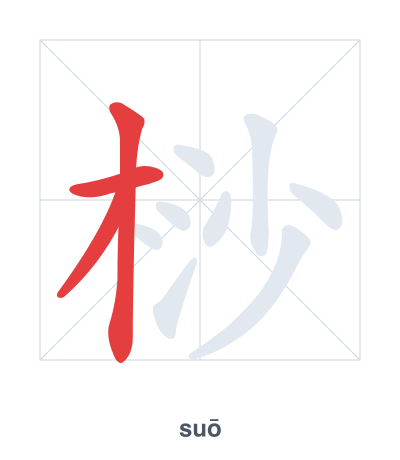
Open Hanzi Writer to see the animated stroke order and practice writing 桫 with real-time feedback.
The character 桫 (suō) is written with 11 strokes. Follow the standard Chinese stroke order: top to bottom, left to right, outside before inside. The radical 木 is one of its key components.
Practice the correct stroke order with the Hanzi Writer app to see animated stroke-by-stroke guidance with real-time feedback.
桫 means Tree fern.
桫 is a phono-semantic compound: the radical 木 (tree) indicates it is a type of tree, and the component 沙 (shā, meaning sand) provides the sound cue (suō), though the pronunciation has shifted. Tree ferns resemble trees but have a trunk texture reminiscent of sand or small particles.
💡 Memory Tip: Picture a tree (木) growing out of a sandy beach (沙) but with fern-like fronds instead of leaves.
桫椤是一种古老的植物。
suō luó shì yī zhǒng gǔ lǎo de zhí wù
The tree fern is an ancient plant.
这里有一片桫椤林。
zhè lǐ yǒu yī piàn suō luó lín
There is a tree fern forest here.
桫椤树长得很高。
suō luó shù zhǎng dé hěn gāo
Tree ferns grow very tall.
Open Hanzi Writer to see the animated stroke order and practice writing 桫 with real-time feedback.
✨ Animated stroke order · Handwriting recognition · HSK-graded practice · Free to use
桫 is made of the radical 木 (tree/wood) on the left and the phonetic component 沙 (suō) on the right. The radical shows it is a type of tree, and the right part hints at the pronunciation suō. Together they indicate a tree fern, a plant that looks like a tree but is a fern.