亏 (kuī) means "Loss or deficit." in Chinese. It has 3 strokes with the radical 二, and is HSK Level 5.
Rated 2.2/5 in difficulty (moderate).
Harder than 0% of HSK Level 5 characters.
Appears in 3+ common words including 吃亏 (chī kuī), 幸亏 (xìng kuī), 亏本 (kuī běn).
Hanzi Writer's stroke validation shows learners typically need 5-8 attempts to write 亏 with correct proportion and order.
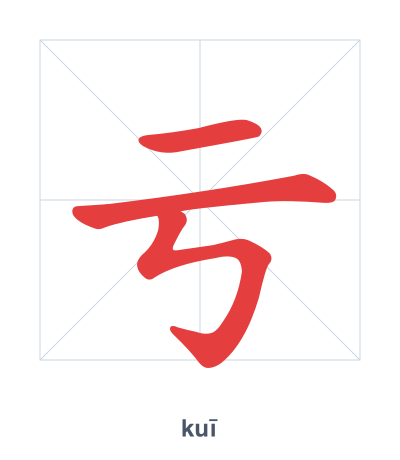
Open Hanzi Writer to see the animated stroke order and practice writing 亏 with real-time feedback.
The character 亏 (kuī) is written with 3 strokes. Follow the standard Chinese stroke order: top to bottom, left to right, outside before inside. The radical 二 is one of its key components.
Practice the correct stroke order with the Hanzi Writer app to see animated stroke-by-stroke guidance with real-time feedback.
亏 means Loss or deficit..
As an HSK Level 5 character, 亏 is an intermediate-level character.
The character 亏 originally depicted a missing or absent piece, akin to a broken or incomplete object. Its ancient form showed a line or shape with a gap, suggesting something that is lacking or has been lost, which directly connects to its meaning of loss or deficit. The radical 二 (two) may reinforce the idea of a split or separation that leads to a shortfall.
💡 Memory Tip: Imagine a smiling face missing its left eye (the top horizontal line and left stroke form a partial face), representing a deficit in happiness.
别担心,你不会吃亏的。
bié dān xīn nǐ bú huì chī kuī de
Don't worry, you won't lose out.
幸亏你来了。
xìng kuī nǐ lái le
Fortunately, you came.
这个生意亏本了。
zhè ge shēng yì kuī běn le
This business lost money.
Open Hanzi Writer to see the animated stroke order and practice writing 亏 with real-time feedback.
✨ Animated stroke order · Handwriting recognition · HSK-graded practice · Free to use
The character 亏 is composed of the radical 二 (two) on top and a vertical hook (亅) below. While the two horizontal lines suggest a pair or balance, the hook below creates an imbalance, symbolizing a loss or deficit. This structure does not directly depict the meaning but helps distinguish it from similar characters.