幸 (xìng) means "Good fortune" in Chinese. It has 8 strokes with the radical 干, and is HSK Level 3.
Rated 3.7/5 in difficulty (challenging).
Harder than 48% of HSK Level 3 characters.
Appears in 3+ common words including 幸福 (xìng fú), 幸运 (xìng yùn), 幸好 (xìng hǎo).
Due to its 8 strokes, Hanzi Writer's error detection shows 幸 requires focused practice — most learners need 10+ attempts for consistent accuracy.
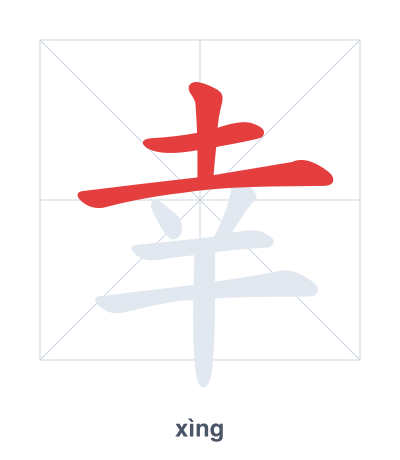
Open Hanzi Writer to see the animated stroke order and practice writing 幸 with real-time feedback.
The character 幸 (xìng) is written with 8 strokes. Follow the standard Chinese stroke order: top to bottom, left to right, outside before inside. The radical 干 is one of its key components.
Practice the correct stroke order with the Hanzi Writer app to see animated stroke-by-stroke guidance with real-time feedback.
幸 means Good fortune.
As an HSK Level 3 character, 幸 is an intermediate-level character.
幸 originally depicted a handcuff or shackle, suggesting that being freed from restraint or punishment was considered fortunate. Over time, the character came to directly mean 'good fortune' or 'luck' as a result of this association.
💡 Memory Tip: Picture two broken chains (丷) falling away from a sturdy staff (干), symbolizing escape from trouble and arriving at good fortune.
我们生活很幸福。
wǒ men shēng huó hěn xìng fú
Our life is very happy.
你真的很幸运。
nǐ zhēn de hěn xìng yùn
You are really lucky.
幸好你来了。
xìng hǎo nǐ lái le
Luckily, you came.
Open Hanzi Writer to see the animated stroke order and practice writing 幸 with real-time feedback.
✨ Animated stroke order · Handwriting recognition · HSK-graded practice · Free to use
The character 幸 is made of the radical 干 (dry) on top and a component like 羊 (sheep) below. The parts do not directly mean good fortune, but the character evolved to represent escaping trouble, which became associated with luck and happiness.