筘 (kòu) means "Reed (of a loom)" in Chinese. It has 12 strokes with the radical 竹.
Rated 4.2/5 in difficulty (advanced).
Appears in 3+ common words including 筘布 (kòu bù), 筘齿 (kòu chǐ), 筘眼 (kòu yǎn).
Due to its 12 strokes, Hanzi Writer's error detection shows 筘 requires focused practice — most learners need 10+ attempts for consistent accuracy.
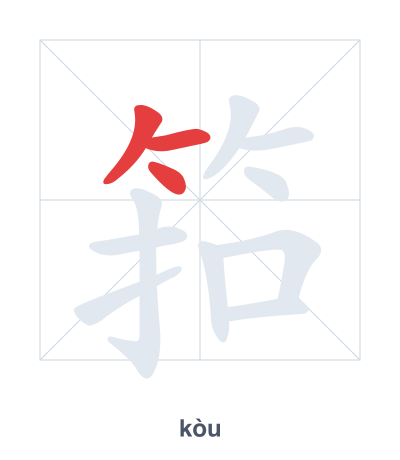
Open Hanzi Writer to see the animated stroke order and practice writing 筘 with real-time feedback.
The character 筘 (kòu) is written with 12 strokes. Follow the standard Chinese stroke order: top to bottom, left to right, outside before inside. The radical 竹 is one of its key components.
Practice the correct stroke order with the Hanzi Writer app to see animated stroke-by-stroke guidance with real-time feedback.
筘 means Reed (of a loom).
This character combines 竹 (bamboo, the material) with 口 (mouth, suggesting an opening or slot) and 寸 (hand), depicting a hand-held bamboo tool with a slot-like structure—the reed of a loom that beats weft threads into place. It is likely a phono-semantic compound where the lower part hints at the sound kòu, akin to 扣 (to knock), referencing the tapping action of the reed.
💡 Memory Tip: Imagine a bamboo (竹) comb with a mouth-like slot (口) that you grip with your hand (寸) to knock the threads tight in the loom.
这种筘布很厚。
zhè zhǒng kòu bù hěn hòu
This reed-woven cloth is very thick.
筘齿坏了一个。
kòu chǐ huài le yí gè
One of the reed teeth is broken.
穿过这个筘眼。
chuān guò zhè ge kòu yǎn
Pass through this reed eye.
Open Hanzi Writer to see the animated stroke order and practice writing 筘 with real-time feedback.
✨ Animated stroke order · Handwriting recognition · HSK-graded practice · Free to use
筘 is made of two parts: the radical 竹 (bamboo) on top, and 口 (mouth) inside 木 (wood) below. The bamboo radical indicates the item is made from bamboo, while the lower part suggests the woven texture of a loom reed. Together, they represent a bamboo tool used in weaving.