恳 (kěn) means "Earnest or sincere." in Chinese. It has 10 strokes with the radical 心, and is HSK Level 7.
Rated 4.2/5 in difficulty (advanced).
Harder than 55% of HSK Level 7 characters.
Appears in 3+ common words including 诚恳 (chéng kěn), 恳求 (kěn qiú), 勤恳 (qín kěn).
Due to its 10 strokes, Hanzi Writer's error detection shows 恳 requires focused practice — most learners need 10+ attempts for consistent accuracy.
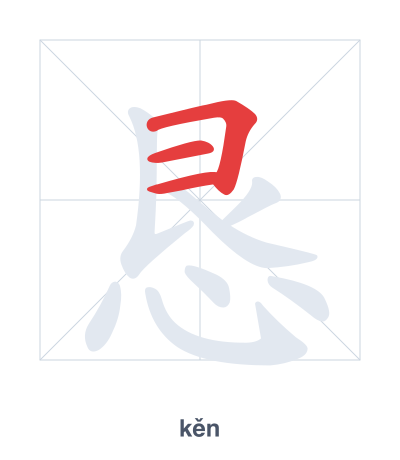
Open Hanzi Writer to see the animated stroke order and practice writing 恳 with real-time feedback.
The character 恳 (kěn) is written with 10 strokes. Follow the standard Chinese stroke order: top to bottom, left to right, outside before inside. The radical 心 is one of its key components.
Practice the correct stroke order with the Hanzi Writer app to see animated stroke-by-stroke guidance with real-time feedback.
恳 means Earnest or sincere..
As an HSK Level 7 character, 恳 is an intermediate-level character.
恳 combines 艮 (root or stubborn) above 心 (heart), showing sincerity that is deeply rooted in one's heart. Originally derived from 懇, which added the phonetic element 豤, the modern form visually emphasizes earnestness as a heartfelt quality.
💡 Memory Tip: Picture a rooted plant (艮) growing from a heart (心), symbolizing earnest feelings that are deeply and sincerely rooted inside.
他的态度很诚恳。
tā de tài dù hěn chéng kěn
His attitude is very earnest.
我恳求你的原谅。
wǒ kěn qiú nǐ de yuán liàng
I beg for your forgiveness.
他工作非常勤恳。
tā gōng zuò fēi cháng qín kěn
He works very hard and conscientiously.
Open Hanzi Writer to see the animated stroke order and practice writing 恳 with real-time feedback.
✨ Animated stroke order · Handwriting recognition · HSK-graded practice · Free to use
恳 is composed of the radical 心 (heart) at the bottom and 艮 (gèn) on top. The heart radical directly connects to sincerity and emotion, while 艮 originally meant 'root' or 'to stop' and here suggests a firm, grounded feeling. Together, they convey a heartfelt, steady earnestness.