慨 (kǎi) means "generous; sigh with emotion" in Chinese. It has 12 strokes with the radical 忄, and is HSK Level 7.
Rated 4.2/5 in difficulty (advanced).
Harder than 57% of HSK Level 7 characters.
Appears in 3+ common words including 感慨 (gǎn kǎi), 慷慨 (kāng kǎi), 愤慨 (fèn kǎi).
Due to its 12 strokes, Hanzi Writer's error detection shows 慨 requires focused practice — most learners need 10+ attempts for consistent accuracy.
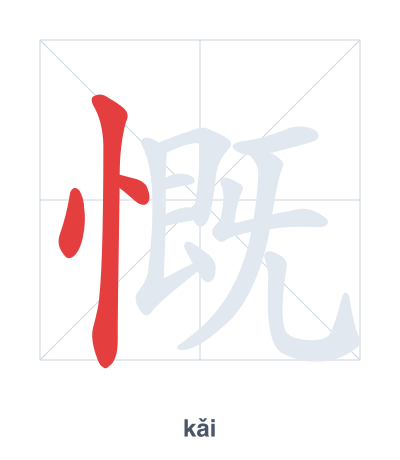
Open Hanzi Writer to see the animated stroke order and practice writing 慨 with real-time feedback.
The character 慨 (kǎi) is written with 12 strokes. Follow the standard Chinese stroke order: top to bottom, left to right, outside before inside. The radical 忄 is one of its key components.
Practice the correct stroke order with the Hanzi Writer app to see animated stroke-by-stroke guidance with real-time feedback.
慨 means generous; sigh with emotion.
As an HSK Level 7 character, 慨 is an intermediate-level character.
慨 combines the heart radical 忄 (emotion) with 既, which originally showed a person finishing a meal, now gives the sound kǎi and suggests 'completed.' Together, they depict a heart that has been fully stirred—hence sighing with emotion or acting with generous feeling.
💡 Memory Tip: Imagine a heart (忄) that's so full it sighs 'Kai!' as it gives away its last coin—the shape of 既 looks like a generous arm reaching out.
他很有感慨。
tā hěn yǒu gǎn kǎi
He is full of emotion.
他为人很慷慨。
tā wéi rén hěn kāng kǎi
He is very generous.
大家感到愤慨。
dà jiā gǎn dào fèn kǎi
Everyone feels indignant.
Open Hanzi Writer to see the animated stroke order and practice writing 慨 with real-time feedback.
✨ Animated stroke order · Handwriting recognition · HSK-graded practice · Free to use
The character 慨 has the radical 忄 (heart) on the left, which connects to emotions and feelings. The right part 既 (jì) provides the sound and originally means 'already,' but together they create meanings like sighing with emotion (heart feeling) or being generous (a heart that gives freely).