Hanzi Writer

How to Write 厥 (jué) — Meaning “his; her; its; their”

jué 12 strokes Radical: 厂

厥 (jué) means "his; her; its; their" in Chinese. It has 12 strokes with the radical 厂.

Rated 3.9/5 in difficulty (challenging).

Appears in 3+ common words including 昏厥 (hūn jué), 大放厥词 (dà fàng jué cí), 厥后 (jué hòu).

Due to its 12 strokes, Hanzi Writer's error detection shows 厥 requires focused practice — most learners need 10+ attempts for consistent accuracy.
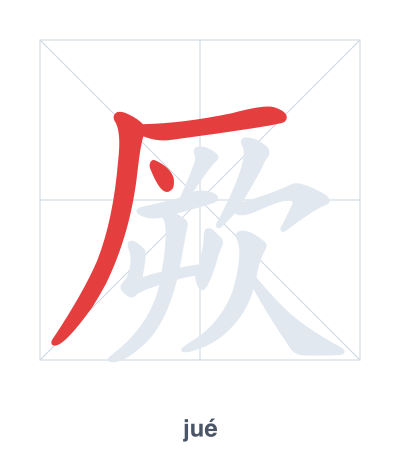
Stroke order practice for 厥 - jué

Practice Writing 厥 (jué)

Open Hanzi Writer to see the animated stroke order and practice writing 厥 with real-time feedback.

The character (jué) is written with 12 strokes. Follow the standard Chinese stroke order: top to bottom, left to right, outside before inside. The radical is one of its key components.

Practice the correct stroke order with the Hanzi Writer app to see animated stroke-by-stroke guidance with real-time feedback.

means his; her; its; their.

Character
Pinyinjué (jue)
Meaninghis; her; its; their
Strokes12
Radical
Difficulty3.9/5

Originally depicting a person with a missing foot (欠) under a cliff (厂), symbolizing a deficiency or fall; this form was later borrowed phonetically to mean the possessive pronoun 'his/her/its'.

💡 Memory Tip: A yawn (欠) makes a sprout (屮) fall off a cliff (厂) — that's his lost plant.

hūn jué
To faint / To lose consciousness
dà fàng jué cí
To spout off or talk nonsense
jué hòu
thereafter; afterwards

他因为太累昏厥了。

tā yīn wèi tài lèi hūn jué le

He fainted because he was too tired.

他在会上大放厥词。

tā zài huì shàng dà fàng jué cí

He talked a lot of nonsense at the meeting.

厥后他离开了家。

jué hòu tā lí kāi le jiā

Thereafter, he left home.

Character Pinyin Strokes Radical
(current) jué 12
cuò 10
yuán 10
xiāng 11
Stroke order practice for 厥 - jué

Practice Writing 厥 (jué)

Open Hanzi Writer to see the animated stroke order and practice writing 厥 with real-time feedback.

✨ Animated stroke order · Handwriting recognition · HSK-graded practice · Free to use

Frequently Asked Questions about 厥

厥 is composed of the radical 厂 (cliff) on top, with 屮 (sprout) and 欠 (lack or yawn) below. The radical suggests a shelter or cliff, but the meaning "his/her/its/their" comes from ancient pronoun usage, not from the visual parts. The character is a phonetic loan, so the components do not directly indicate the meaning.

Characters with Radical 厂

Other 12-Stroke Characters