窭 (jù) means "poor / impoverished" in Chinese. It has 14 strokes with the radical 穴.
Rated 4.2/5 in difficulty (advanced).
Appears in 3+ common words including 贫窭 (pín jù), 窭陋 (jù lòu), 窭人 (jù rén).
Due to its 14 strokes, Hanzi Writer's error detection shows 窭 requires focused practice — most learners need 10+ attempts for consistent accuracy.
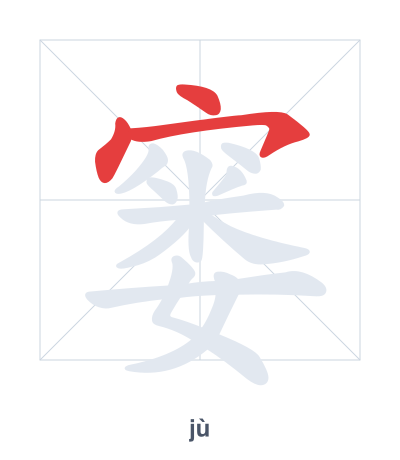
Open Hanzi Writer to see the animated stroke order and practice writing 窭 with real-time feedback.
The character 窭 (jù) is written with 14 strokes. Follow the standard Chinese stroke order: top to bottom, left to right, outside before inside. The radical 穴 is one of its key components.
Practice the correct stroke order with the Hanzi Writer app to see animated stroke-by-stroke guidance with real-time feedback.
窭 means poor / impoverished.
The character 窭 combines the radical 穴 (cave or pit) with 娄 (a phonetic component that also suggests a basket). It originally depicted a cramped, poor dwelling, like a cave where a person's only possession is a basket—symbolizing extreme poverty.
💡 Memory Tip: Picture a person living in a cave (穴) with only a tattered basket (娄) to hold their few belongings, showing they are utterly poor.
他的生活非常贫窭。
tā de shēng huó fēi cháng pín jù
His life is very impoverished.
这里的房屋很窭陋。
zhè lǐ de fáng wū hěn jù lòu
The houses here are very shabby.
他是一个诚实的窭人。
tā shì yí gè chéng shí de jù rén
He is an honest poor man.
Open Hanzi Writer to see the animated stroke order and practice writing 窭 with real-time feedback.
✨ Animated stroke order · Handwriting recognition · HSK-graded practice · Free to use
窭 is composed of the radical 穴 (cave) on top and 娄 (a phonetic component that can mean 'basket' or 'hollow') below. The cave radical suggests a confined, humble space, while 娄 adds the idea of emptiness or hollow, together conveying a sense of extreme poverty or lacking resources.