犟 (jiàng) means "stubborn; obstinate" in Chinese. It has 16 strokes with the radical 牛.
Rated 4.2/5 in difficulty (advanced).
Appears in 3+ common words including 犟脾气 (jiàng pí qì), 犟嘴 (jiàng zuǐ), 犟 (jiàng).
Due to its 16 strokes, Hanzi Writer's error detection shows 犟 requires focused practice — most learners need 10+ attempts for consistent accuracy.
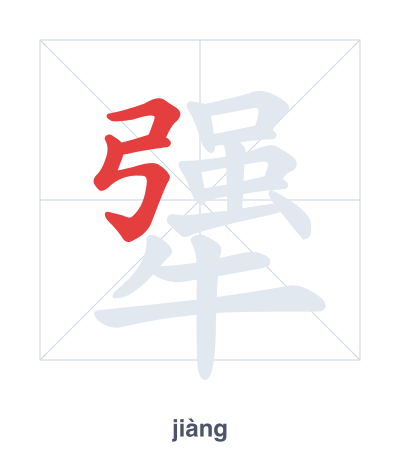
Open Hanzi Writer to see the animated stroke order and practice writing 犟 with real-time feedback.
The character 犟 (jiàng) is written with 16 strokes. Follow the standard Chinese stroke order: top to bottom, left to right, outside before inside. The radical 牛 is one of its key components.
Practice the correct stroke order with the Hanzi Writer app to see animated stroke-by-stroke guidance with real-time feedback.
犟 means stubborn; obstinate.
| Character | 犟 |
| Pinyin | jiàng (jiang) |
| Meaning | stubborn; obstinate |
| Strokes | 16 |
| Radical | 牛 |
| Difficulty | 4.2/5 |
犟 combines the radical 牛 (ox) with 强 (strong), depicting a strong ox that refuses to budge—a vivid symbol of stubbornness.
💡 Memory Tip: Picture a powerful ox (牛) planted firmly, straining against a harness with all its might, utterly refusing to move an inch.
他是个犟脾气。
tā shì gè jiàng pí qì
He is a stubborn person.
别跟爸爸犟嘴。
bié gēn bà bà jiàng zuǐ
Don't talk back to your father.
他的性格很犟。
tā de xìng gé hěn jiàng
He has a very stubborn personality.
Open Hanzi Writer to see the animated stroke order and practice writing 犟 with real-time feedback.
✨ Animated stroke order · Handwriting recognition · HSK-graded practice · Free to use
犟 is composed of 牛 (ox) on top and 強 (strong) below. The ox is known for being stubborn, so the character visually suggests a strong-willed or obstinate ox, which matches the meaning of stubbornness.