犒 (kào) means "to reward with food or drink" in Chinese. It has 14 strokes with the radical 牛.
Rated 4.2/5 in difficulty (advanced).
Appears in 2+ common words including 犒劳 (kào láo), 犒赏 (kào shǎng).
Due to its 14 strokes, Hanzi Writer's error detection shows 犒 requires focused practice — most learners need 10+ attempts for consistent accuracy.
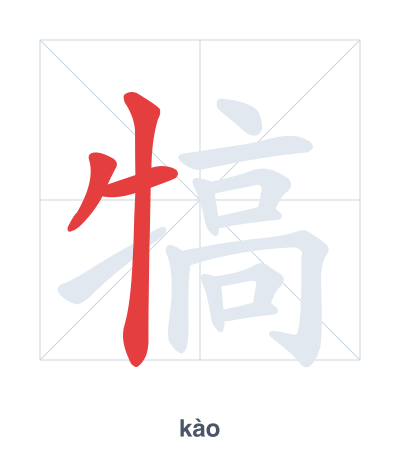
Open Hanzi Writer to see the animated stroke order and practice writing 犒 with real-time feedback.
The character 犒 (kào) is written with 14 strokes. Follow the standard Chinese stroke order: top to bottom, left to right, outside before inside. The radical 牛 is one of its key components.
Practice the correct stroke order with the Hanzi Writer app to see animated stroke-by-stroke guidance with real-time feedback.
犒 means to reward with food or drink.
| Character | 犒 |
| Pinyin | kào (kao) |
| Meaning | to reward with food or drink |
| Strokes | 14 |
| Radical | 牛 |
| Difficulty | 4.2/5 |
犒 combines the radical 牛 (cow/ox), representing meat or livestock for feasting, with 高 (gāo, tall/high) as a phonetic component. Its ancient meaning was to reward soldiers or workers with food and drink, especially after a military campaign—literally offering cattle to those in high positions or at a high occasion.
💡 Memory Tip: Picture a cow (牛) hoisted high (高) on a platform, being cooked and served to reward tired troops.
妈妈做饭犒劳我。
mā mā zuò fàn kào láo wǒ
Mom cooked a meal to reward me.
老师犒赏了学生。
lǎo shī kào shǎng le xué shēng
The teacher rewarded the students.
我们去吃大餐犒劳自己。
wǒ men qù chī dà cān kào láo zì jǐ
Let's treat ourselves to a big meal.
Open Hanzi Writer to see the animated stroke order and practice writing 犒 with real-time feedback.
✨ Animated stroke order · Handwriting recognition · HSK-graded practice · Free to use
犒 combines the radical 牛 (cow or ox) on the left with the phonetic component 高 (gāo, meaning tall or high) on the right. The cow/ox radical suggests the idea of offering or using animals for food, while 高 gives the pronunciation. Together, the character means "to reward someone with food or drink," often for hard work or service.