迹 (jì) means "Trace; mark" in Chinese. It has 9 strokes with the radical 辶, and is HSK Level 7.
Rated 4/5 in difficulty (challenging).
Harder than 46% of HSK Level 7 characters.
Appears in 3+ common words including 足迹 (zú jì), 奇迹 (qí jì), 迹象 (jì xiàng).
Due to its 9 strokes, Hanzi Writer's error detection shows 迹 requires focused practice — most learners need 10+ attempts for consistent accuracy.
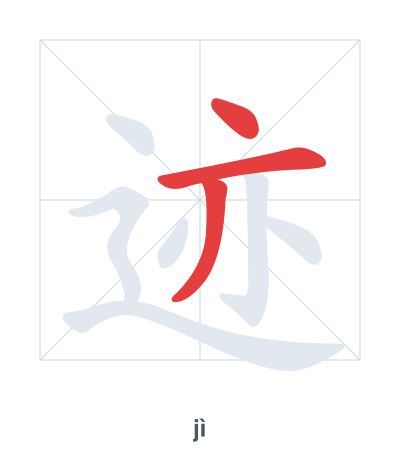
Open Hanzi Writer to see the animated stroke order and practice writing 迹 with real-time feedback.
The character 迹 (jì) is written with 9 strokes. Follow the standard Chinese stroke order: top to bottom, left to right, outside before inside. The radical 辶 is one of its key components.
Practice the correct stroke order with the Hanzi Writer app to see animated stroke-by-stroke guidance with real-time feedback.
迹 means Trace; mark.
As an HSK Level 7 character, 迹 is an intermediate-level character.
The character 迹 combines the radical 辶 (to walk) with 亦 (yì, also) as a phonetic component. It originally depicted the mark or footprint left behind as one walks, hence its meaning of 'trace' or 'mark'.
💡 Memory Tip: A walker (辶) takes a step, and also (亦) leaves a clear footprint behind.
沙滩上有很多足迹。
shā tān shàng yǒu hěn duō zú jì
There are many footprints on the beach.
这是一个伟大的奇迹。
zhè shì yí gè wěi dà de qí jì
This is a great miracle.
天气没有好转的迹象。
tiān qì méi yǒu hǎo zhuǎn de jì xiàng
There are no signs of the weather improving.
Open Hanzi Writer to see the animated stroke order and practice writing 迹 with real-time feedback.
✨ Animated stroke order · Handwriting recognition · HSK-graded practice · Free to use
迹 consists of the radical 辶 (walk) on the left and the component 亦 on the right. The radical 辶 relates to movement or walking, and the character as a whole means a trace or mark left by movement, like a footprint.