唤 (huàn) means "To call / To summon" in Chinese. It has 10 strokes with the radical 口, and is HSK Level 7.
Rated 4.2/5 in difficulty (advanced).
Harder than 48% of HSK Level 7 characters.
Appears in 3+ common words including 叫唤 (jiào huàn), 呼唤 (hū huàn), 唤醒 (huàn xǐng).
Due to its 10 strokes, Hanzi Writer's error detection shows 唤 requires focused practice — most learners need 10+ attempts for consistent accuracy.
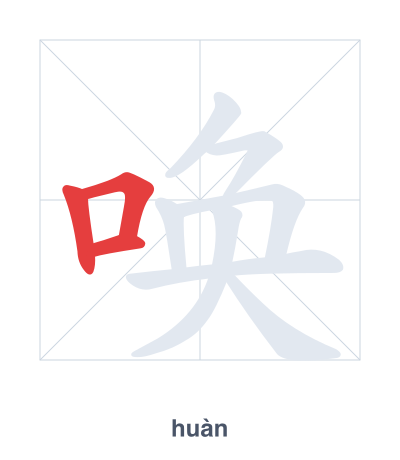
Open Hanzi Writer to see the animated stroke order and practice writing 唤 with real-time feedback.
The character 唤 (huàn) is written with 10 strokes. Follow the standard Chinese stroke order: top to bottom, left to right, outside before inside. The radical 口 is one of its key components.
Practice the correct stroke order with the Hanzi Writer app to see animated stroke-by-stroke guidance with real-time feedback.
唤 means To call / To summon.
As an HSK Level 7 character, 唤 is an intermediate-level character.
唤 is a phono-semantic compound character. The left radical 口 (mouth) indicates the action involves speaking or calling. The right component 奂 (huàn, meaning 'exchange' or 'bright') provides the phonetic element, suggesting the calling is a form of verbal exchange or summons.
💡 Memory Tip: Imagine a mouth (口) calling out 'Huan!' to a big person (大) holding a knife (刀) to summon them immediately.
小狗在叫唤。
xiǎo gǒu zài jiào huàn
The puppy is barking.
妈妈在呼唤我。
mā mā zài hū huàn wǒ
Mom is calling me.
闹钟唤醒了我。
nào zhōng huàn xǐng le wǒ
The alarm clock woke me up.
Open Hanzi Writer to see the animated stroke order and practice writing 唤 with real-time feedback.
✨ Animated stroke order · Handwriting recognition · HSK-graded practice · Free to use
唤 combines the radical 口 (mouth) on the left, and 奂 (huàn, meaning 'exchange' or 'bright') on the right. The mouth radical indicates the action involves speaking or making sound, while 奂 gives the pronunciation and subtly suggests the idea of causing a change, like calling someone to come or wake up.