歛 (hān) means "To collect or restrain" in Chinese. It has 17 strokes with the radical 欠.
Rated 4.2/5 in difficulty (advanced).
Appears in 3+ common words including 歛财 (hān cái), 收歛 (shōu hān), 歛迹 (hān jì).
Due to its 17 strokes, Hanzi Writer's error detection shows 歛 requires focused practice — most learners need 10+ attempts for consistent accuracy.
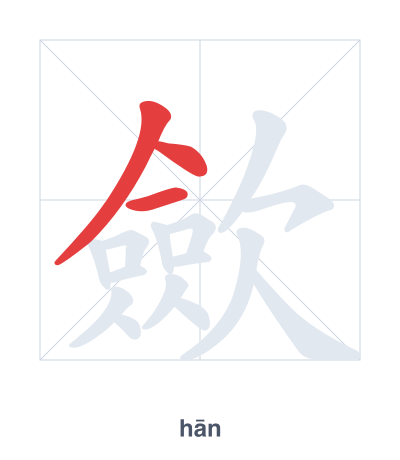
Open Hanzi Writer to see the animated stroke order and practice writing 歛 with real-time feedback.
The character 歛 (hān) is written with 17 strokes. Follow the standard Chinese stroke order: top to bottom, left to right, outside before inside. The radical 欠 is one of its key components.
Practice the correct stroke order with the Hanzi Writer app to see animated stroke-by-stroke guidance with real-time feedback.
歛 means To collect or restrain.
| Character | 歛 |
| Pinyin | hān (han) |
| Meaning | To collect or restrain |
| Strokes | 17 |
| Radical | 欠 |
| Difficulty | 4.2/5 |
This compound character combines 佥 (qiān, meaning 'all' or 'together') with the radical 欠 (qiàn, depicting a person with an open mouth, often associated with breath or yawning). Together, they suggest the idea of drawing breath in or pulling everything together, which evolved into the meanings 'to collect' or 'to restrain.'
💡 Memory Tip: Picture a person yawning (欠) and using that breath to suck in every last coin (佥) as they collect and restrain all the scattered money.
他通过不正当手段歛财。
tā tōng guò bù zhèng dāng shǒu duàn hān cái
He amassed wealth through improper means.
请收歛一下你的脾气。
qǐng shōu hān yī xià nǐ de pí qì
Please restrain your temper.
他从此在江湖歛迹。
tā cóng cǐ zài jiāng hú hān jì
He withdrew from the martial arts world from then on.
Open Hanzi Writer to see the animated stroke order and practice writing 歛 with real-time feedback.
✨ Animated stroke order · Handwriting recognition · HSK-graded practice · Free to use
The character 歛 has two main parts: the left side 僉 (qiān, meaning 'all' or 'together') and the right side 欠 (qiàn, meaning 'to yawn' or 'lack'). Together, they suggest gathering or restraining something into one place. The 欠 radical hints at an action involving breathing or restraint, while 僉 gives the sense of bringing things together.