李 (lǐ) means "Plum; Li (surname)" in Chinese. It has 7 strokes with the radical 木, and is HSK Level 3.
Rated 3.5/5 in difficulty (challenging).
Harder than 41% of HSK Level 3 characters.
Appears in 3+ common words including 李子 (lǐ zi), 行李 (xíng lǐ), 李先生 (lǐ xiān shēng).
Due to its 7 strokes, Hanzi Writer's error detection shows 李 requires focused practice — most learners need 10+ attempts for consistent accuracy.
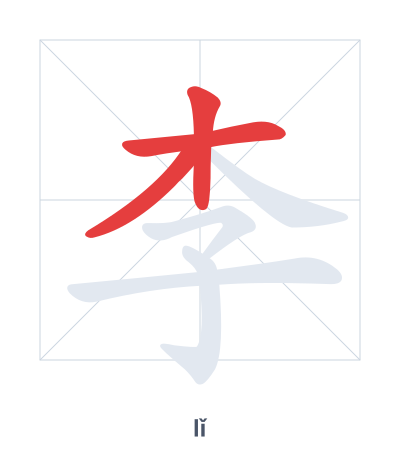
Open Hanzi Writer to see the animated stroke order and practice writing 李 with real-time feedback.
The character 李 (lǐ) is written with 7 strokes. Follow the standard Chinese stroke order: top to bottom, left to right, outside before inside. The radical 木 is one of its key components.
Practice the correct stroke order with the Hanzi Writer app to see animated stroke-by-stroke guidance with real-time feedback.
李 means Plum; Li (surname).
As an HSK Level 3 character, 李 is an intermediate-level character.
李 is a compound character combining 木 (tree) and 子 (child). The 'child of the tree' suggests the fruit that grows from it, specifically the plum.
💡 Memory Tip: Imagine a little child (子) climbing a tree (木) to pluck sweet plums.
这些李子很甜。
zhè xiē lǐ zi hěn tián
These plums are very sweet.
你的行李重吗?
nǐ de xíng lǐ zhòng ma
Is your luggage heavy?
李先生是我的老师。
lǐ xiān shēng shì wǒ de lǎo shī
Mr. Li is my teacher.
Open Hanzi Writer to see the animated stroke order and practice writing 李 with real-time feedback.
✨ Animated stroke order · Handwriting recognition · HSK-graded practice · Free to use
李 is composed of two parts: the top is 木 (wood/tree) and the bottom is 子 (child). Together, they suggest a tree producing small fruit like plums, as 子 can represent the small offspring of the tree. This structure directly connects to the meaning "plum" and also serves as a common surname.